A CVSS 9.8 and a CVSS 9.8 are not the same finding
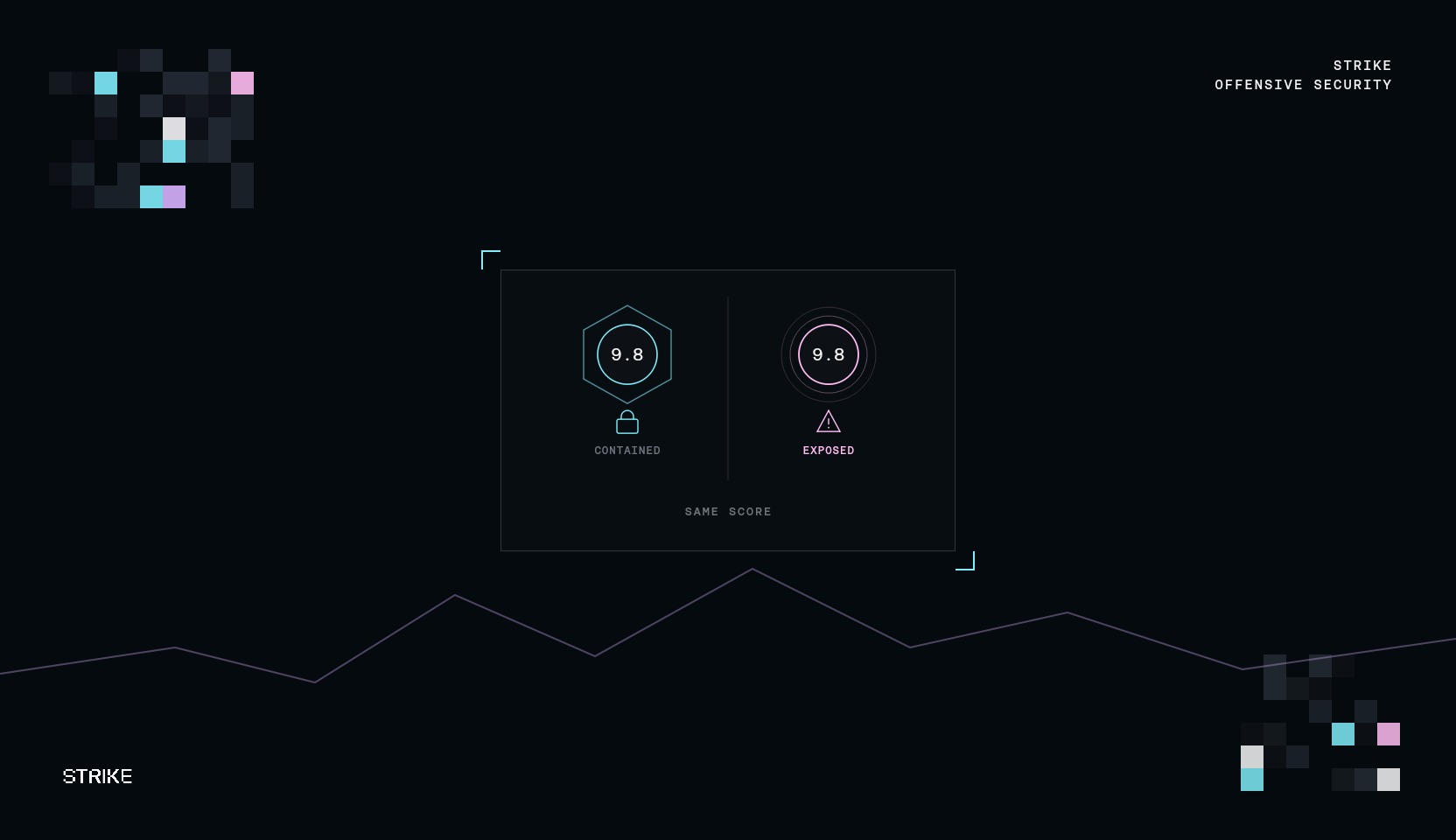
Two findings can carry the exact same CVSS score and mean completely different things for the week ahead.
One sits behind a WAF, in an internal staging environment, with limited accessibility and no evidence of active exploitation. The other is on a public-facing production endpoint, trivially reachable, with known exploitation already reported for the underlying vulnerability.
Same number. Very different priority.
A severity score measures the technical characteristics of a vulnerability, but it doesn't tell the whole story. In fact, CVSS itself distinguishes between the intrinsic severity of a vulnerability and the threat and environmental context that can affect its relevance to a specific organization.
A score alone doesn't tell you how exposed the affected asset is, how easily an attacker can reach it, which security controls stand in the way, or what is happening in the current threat landscape.
That's the gap between “critical on paper” and “urgent right now.”
Closing that gap is what effective prioritization is about.
What goes into a priority call
When Strike's Hacking Team validates and prioritizes a finding, severity is a starting point, not the entire answer.
Every validated exposure is prioritized using multiple layers of context.
Accessibility and visibility
How reachable is the exposure?
A vulnerability on a public-facing endpoint presents a different situation from one that requires internal network access, valid credentials, or a specific sequence of actions before an attacker can even reach it.
Strike considers where an exposure sits, how visible it is, and what an attacker needs to reach it. This helps establish the real attack opportunity around the finding.
Real exploitability
There's an important difference between a vulnerability that could theoretically be exploited and one that has actually been validated.
Strike goes beyond identifying potential weaknesses by testing whether vulnerabilities can be exploited and providing reproducible evidence when exploitation is successful.
That evidence changes the conversation. Instead of asking whether something might be exploitable, security teams can see what an attacker was actually able to do.
Asset context
The same vulnerability can carry very different risk depending on where it lives.
Is the affected asset in production or staging? Is it customer-facing or internal? Does it support a critical business process? What kind of information or functionality sits behind it?
Strike incorporates this asset context into prioritization, helping teams understand the potential impact of a successful attack rather than treating every affected system as equivalent.
Security control context
What's already standing between an attacker and the exposure?
Controls such as a WAF, authentication requirements, rate limiting, network segmentation, and other compensating controls can affect how an attacker could reach and exploit a vulnerability.
They don't make the underlying vulnerability disappear, but they change its real-world exposure. Strike considers these controls when determining what requires the most immediate attention.
Threat intelligence and real-world attacker activity
Exploitability isn't static. What looks like a theoretical risk today can become an immediate priority when attacker behavior changes.
That's why Strike incorporates real-world threat intelligence into how findings are prioritized. This includes evidence of active exploitation in the wild, known exploitation of specific CVEs, the availability of public exploit code, and observed attacker techniques associated with the exposure.
These signals add an external layer of context to what Strike has already validated inside the customer's environment.
For example, a vulnerability that is externally accessible and reproducibly exploitable becomes more urgent when there is also evidence that attackers are actively targeting it in the wild. Conversely, a high-severity vulnerability with no known exploitation, limited accessibility, and effective compensating controls may require a different remediation timeline.
The goal isn't to replace technical severity with threat intelligence. It's to combine what could happen, what Strike was able to validate, and what attackers are actually doing to build a more realistic picture of priority.
Context changes the priority
No single signal determines priority on its own.
Strike looks at every validated exposure from multiple angles:
- Can an attacker see it? Visibility and external exposure.
- Can an attacker reach it? Accessibility, authentication requirements, and network position.
- Can it actually be exploited? Validated exploitability and reproducible evidence.
- What sits behind it? Asset criticality, environment, data, and business context.
- What stands in front of it? WAFs, authentication, segmentation, rate limiting, and other security controls.
- Are attackers already targeting it? Active exploitation, public exploit availability, and relevant threat intelligence.
Together, these signals provide a more realistic view of an exposure than severity alone.
A lower-severity vulnerability that is internet-facing, easy to reach, reproducibly exploitable, unprotected by compensating controls, and associated with active attacker behavior may deserve attention before a critical vulnerability buried inside a tightly controlled environment.
That doesn't make the severity score wrong. It means severity and priority answer different questions.
Severity describes the technical characteristics of a vulnerability. Priority answers the operational question security teams actually face: what should we fix first?
Why this matters more than the score itself
When teams triage findings based only on CVSS, they lose the context that determines how an exposure behaves in their actual environment.
A team might spend its next sprint addressing a high-scoring vulnerability protected by multiple controls while a lower-scored, internet-facing and exploitable issue remains in the backlog.
The CVSS score didn't lie. It simply wasn't designed to capture all of that context. FIRST itself recommends supplementing Base scores with threat and environmental information rather than using them alone for risk-based prioritization.
Combining severity with accessibility, visibility, validated exploitability, asset context, security control context, and real-world threat intelligence gives security teams a much clearer picture of what deserves attention first.
The result isn't just a ranked list of vulnerabilities. It's a view of exposure grounded in what attackers can see, what they can reach, what they can exploit, and what matters most in that specific environment.
That's the difference between knowing what's vulnerable and knowing what to work on next.
Curious how Strike turns a detected vulnerability into actionable evidence? Book a demo and see how findings are validated, contextualized, and prioritized within the platform.

Get offensive security insights, straight to your inbox
Subscribe to Strike’s newsletter for real-world strategies, threat intel, and expert takes on staying secure in an evolving landscape.