
Strike vs Cobalt: which PTaaS fits your team?
Both Strike and Cobalt are pentest-as-a-service platforms that pair human expertise with a delivery platform. The practical difference is the unit you buy: Cobalt sells credits — eight-hour blocks of testing time in annual packages — while Strike sells continuous coverage of an attack surface. That one choice shapes your cost, your cadence, and how much of the year actually gets tested.

Who ends up comparing these two
Security leads renewing a pentest contract who have started counting how many months of the year were actually covered.
Teams whose testing budget is measured in hours, and who keep deciding not to test something because it would spend a credit.
Companies selling into or out of LATAM that need reports in Spanish or Portuguese with local regulatory context, not a translated US report.
The difference is the unit you buy
Cobalt and Strike agree on the premise: penetration testing should be delivered through a platform rather than a PDF, and human expertise should be part of it. Where the two diverge is what a contract actually buys. Cobalt sells testing time — credits, in eight-hour units, in annual packages. Strike sells continuous coverage of a surface. Almost everything else in this comparison follows from that one decision.
Your programme is genuinely project-shaped. If what you need is one annual pentest for a compliance checkbox — scoped, budgeted and closed like any other engagement — a credit package maps to how you already work. Continuous coverage would be paying for something you have not decided you need.
Your security review requires a long-standing US-headquartered vendor. That is a legitimate procurement constraint, and Cobalt clears it comfortably.
You are buying coverage, not hours. Eight-hour credits make you ration testing. A subscription scoped to your surface does not, so nobody on your team has to decide whether a new endpoint is worth spending a credit on.
You want the precision published and defined. 97% precision and under 3% false positives, with the definition, period and universe written down on our methodology page rather than asserted in a sales deck.
You operate in LATAM or sell into it. Native Spanish and Brazilian Portuguese, and reports that speak to LGPD, the CMN/BACEN cybersecurity policy, the CNBV and the SFC — not a translated US report.
You retest constantly. Every retest is included and attached to the finding it closes, so verifying a fix never becomes a conversation about consuming hours.
Strike vs Cobalt, answered
Is Strike a Cobalt alternative?
Yes. Both are pentest-as-a-service platforms combining human expertise with a delivery platform, and teams routinely evaluate them against each other. The difference is not the quality of the testers, it is the unit you buy: blocks of testing time versus continuous coverage of a surface.
What actually changes between credits and a subscription?
Behaviour. With credits, every test is a decision about spending a finite budget of hours, so testing concentrates around audits and big releases. With a subscription the cost does not move when your team asks for one more thing to be tested — so it gets tested.
Can we migrate mid-contract?
Yes, and most teams overlap deliberately. Strike does not sit inline with anything, so onboarding is scoping plus access and takes under five minutes. We can start covering your surface while your existing contract runs out, and you compare the two on real findings rather than on slides.
Does Strike have a public pentester community like Cobalt Core?
No, and it is a deliberate trade-off. Strike's model is AI execution supervised by a dedicated hacking governance team that validates every finding. It is powered by security experts who sit in the halls of fame of companies like Meta, Amazon and Apple. You get consistency and continuity; Cobalt's model gives you breadth of individually named researchers.
How do the two compare on price?
Neither company publishes list prices. Strike tends to be 130× faster to validate exposure and 15–30× more efficient than anything else in the industry. The comparison worth doing is total annual cost for the same assets with retests included, rather than a headline rate.
All Cobalt claims above are quoted from Cobalt's own public materials. [1] Cobalt, "What is Penetration Testing as a Service (PTaaS)?", cobalt.io learning center — consulted 24 July 2026. [2] Cobalt pricing page, cobalt.io/pricing — consulted 24 July 2026.
Where a row reads "not published" or "not stated publicly", it means we could not find the figure in Cobalt's public materials on that date — not that the capability is absent. Strike's own figures are defined on our methodology page.
ALWAYS-ON PLATFORM
More than a test. A strategic layer for real security.
Our AI is powered by a proprietary data layer built from thousands of hours of pentesting and real-world validations. Strike combines autonomous execution and expert human validation to uncover complex risks, reduce noise, and prioritize actionable findings.

In-depth continuous testing
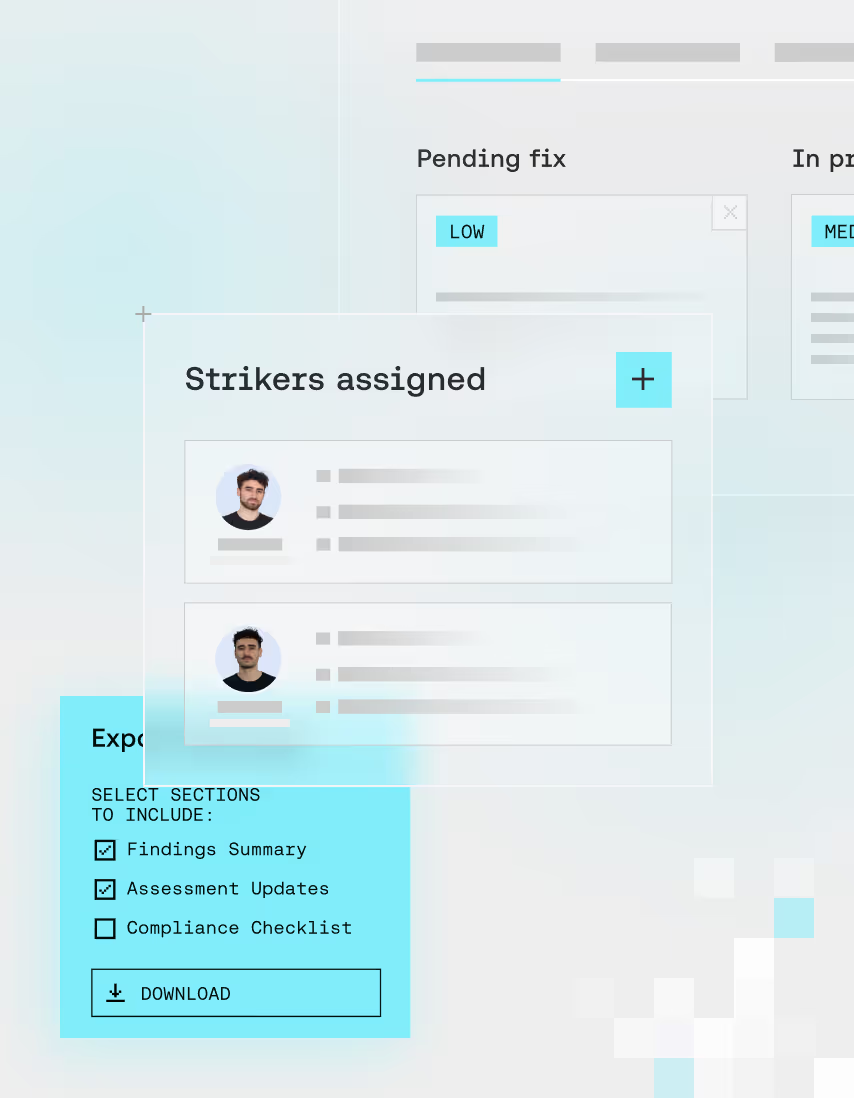
Strikers uncover high-impact vulnerabilities across multi-technology environments (web apps, APIs, mobile, cloud, and more).

AI-led retesting on-demand
Validate fixes instantly, without waiting for the next testing cycle.

Real-time fixing
AI agents guide your team step-by-step through remediation to accelerate resolution.

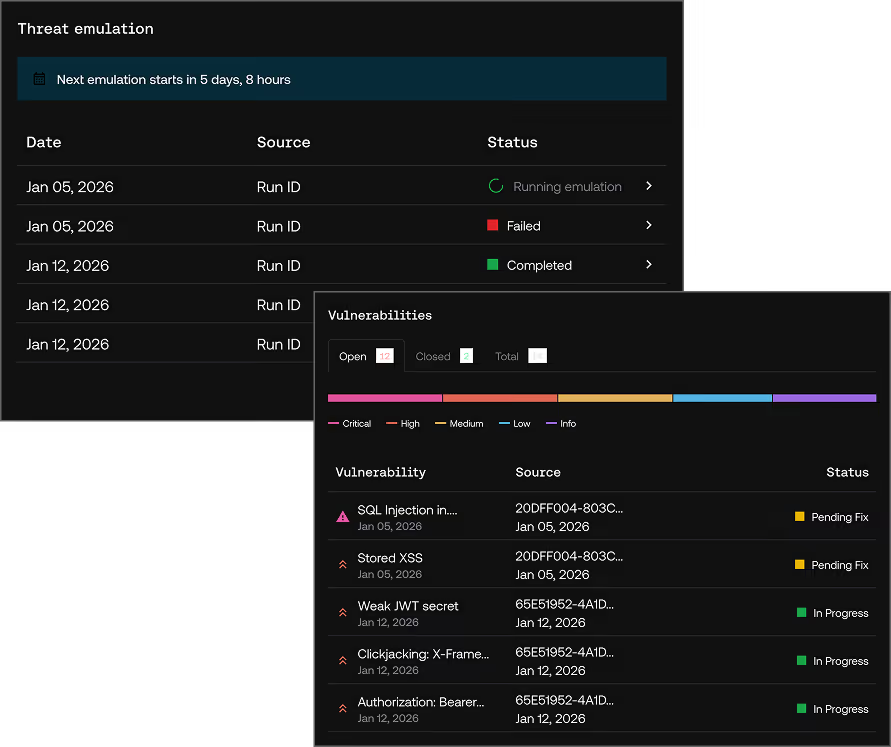
Step-by-step Threat emulation creation
Easily scope, launch, and track your Threat emulation with full transparency.

Human triaging & peer review
Every finding is validated by security experts to ensure accuracy and impact.

Full visibility
Track every finding with complete transparency through security expert work logs and real-time notifications.

Seamless integrations
Connect directly with Slack, Teams and Jira to streamline collaboration with your security and development teams.

Vulnerability Manager
Visualize, manage, and retest vulnerabilities in one platform, with full context on severity, sources, and remediation.

Compliance-ready reporting
Automatically generate up-to-date reports aligned with PCI DSS, HIPAA, ISO 27001, SOC 2, and more.

Ongoing partnership
Weekly check-ins with a dedicated Customer Success Manager, plus personalized onboarding and strategic planning.
More than an offensive security platform, Strike operates as a continuous validation layer for environments that never stop changing.

Trusted by security teams that lead






Human expertise.
AI power.
Superior security.
Whether you’re scaling fast, closing enterprise deals, or just tired of noisy reports, we’ll help you build a security stack that moves faster than your threats.
