
What is automated penetration testing?
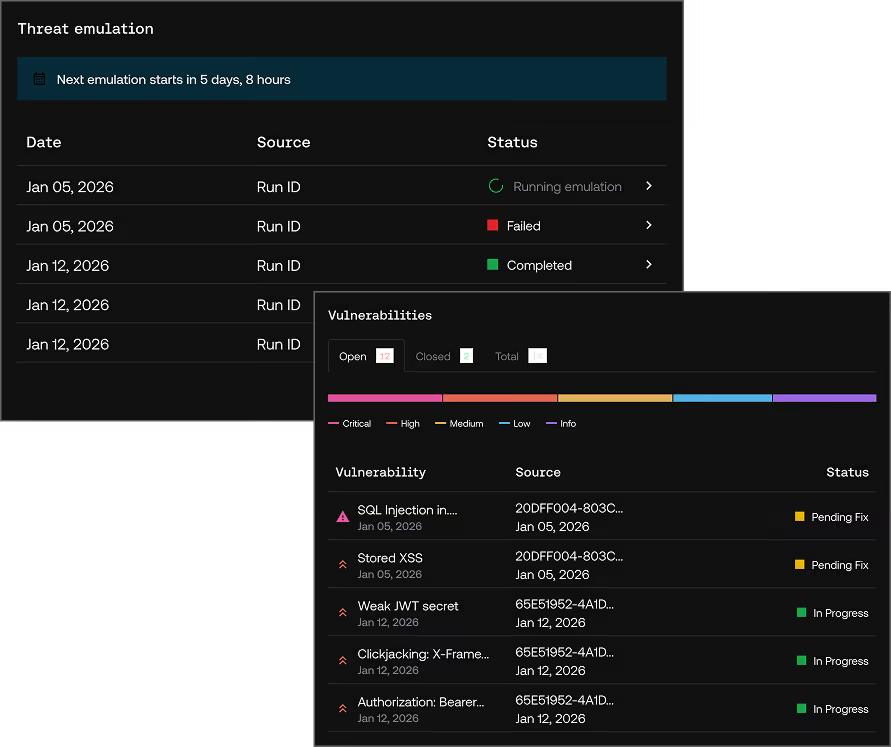
Automated penetration testing uses software to execute attack techniques against a defined scope without a human driving each step. It runs faster and more often than a manual engagement, and it covers ground that would be uneconomic to cover by hand. What it does not do is decide whether a finding matters. This guide covers what automation replaces, what it does not, how it differs from a scanner, and the questions worth asking a vendor before you buy.


Who this guide is for
AppSec teams evaluating whether automated testing can carry coverage and cadence that manual engagements cannot reach economically.
Engineering organisations shipping frequently, who need each release exercised without waiting for a scheduled engagement.
Buyers who need to separate a genuine automation capability from a vulnerability scanner sold under a better name.
What automation replaces, and what it does not
Automation replaces coverage and cadence, the parts of testing that scale with compute, and it removes the calendar dependency of a scheduled engagement. It does not replace novel business-logic abuse, judgement about impact, or adversarial creativity. The useful framing is not automated versus manual, but which layer does which job.
Automated penetration testing, answered
What is automated penetration testing?
Automated penetration testing uses software to execute attack techniques against a defined scope without a human driving each step. It runs faster and more often than a manual engagement and covers ground that would be uneconomic to cover by hand. What it does not do is decide whether a finding matters.
What does automation replace, and what does it not?
It replaces coverage and cadence, the parts of testing that scale with compute, and it removes the calendar dependency of a scheduled engagement. It does not replace novel business-logic abuse, judgement about impact, or adversarial creativity. The useful framing is not automated versus manual, but which layer does which job.
How is it different from a vulnerability scanner or DAST?
A scanner reports conditions that may be exploitable. Automated penetration testing attempts to prove it. The practical difference is who absorbs the cost of finding out: with a scanner, your team; with validated testing, the vendor. They are complements, not alternatives.
Is automated penetration testing as good as a manual pentest?
For coverage and cadence it is better, because no team runs the same technique weekly across a large scope by hand. For novel business-logic abuse and impact judgement, expertise still leads. Mature programs use both.
Does it satisfy SOC 2, ISO 27001 or PCI DSS?
It produces dated, repeatable evidence that supports audit and compliance programs. No testing vendor issues certifications; that decision belongs to the auditor. Strike gives auditors the validated evidence they ask for.
Primary sources, consulted on 2026-07-28: AICPA, SOC 2 - Trust Services Criteria, ISO/IEC 27001:2022 and PCI SSC, PCI Data Security Standard.
How does Strike approach automated penetration testing?
Strike combines AI-led execution with expert human validation before customer delivery. The AI platform operates on web applications and APIs; mobile, infrastructure, networks and adversarial exercises are covered by expert-led manual testing under Projects. Coverage depends on the authorised scope and the access granted. Three separate timings, which should not be merged: platform setup takes under 5 minutes on supported scopes, execution start depends on scope authorisation and access, and findings arrive in 1-2 hours to the curated set. Strike reports 97% precision and under 3% false positives.
Trusted by security teams that lead






Human expertise.
AI power.
Superior security.
Whether you’re scaling fast, closing enterprise deals, or just tired of noisy reports, we’ll help you build a security stack that moves faster than your threats.
