The Binance hack: How compromised access can put an entire operation at risk
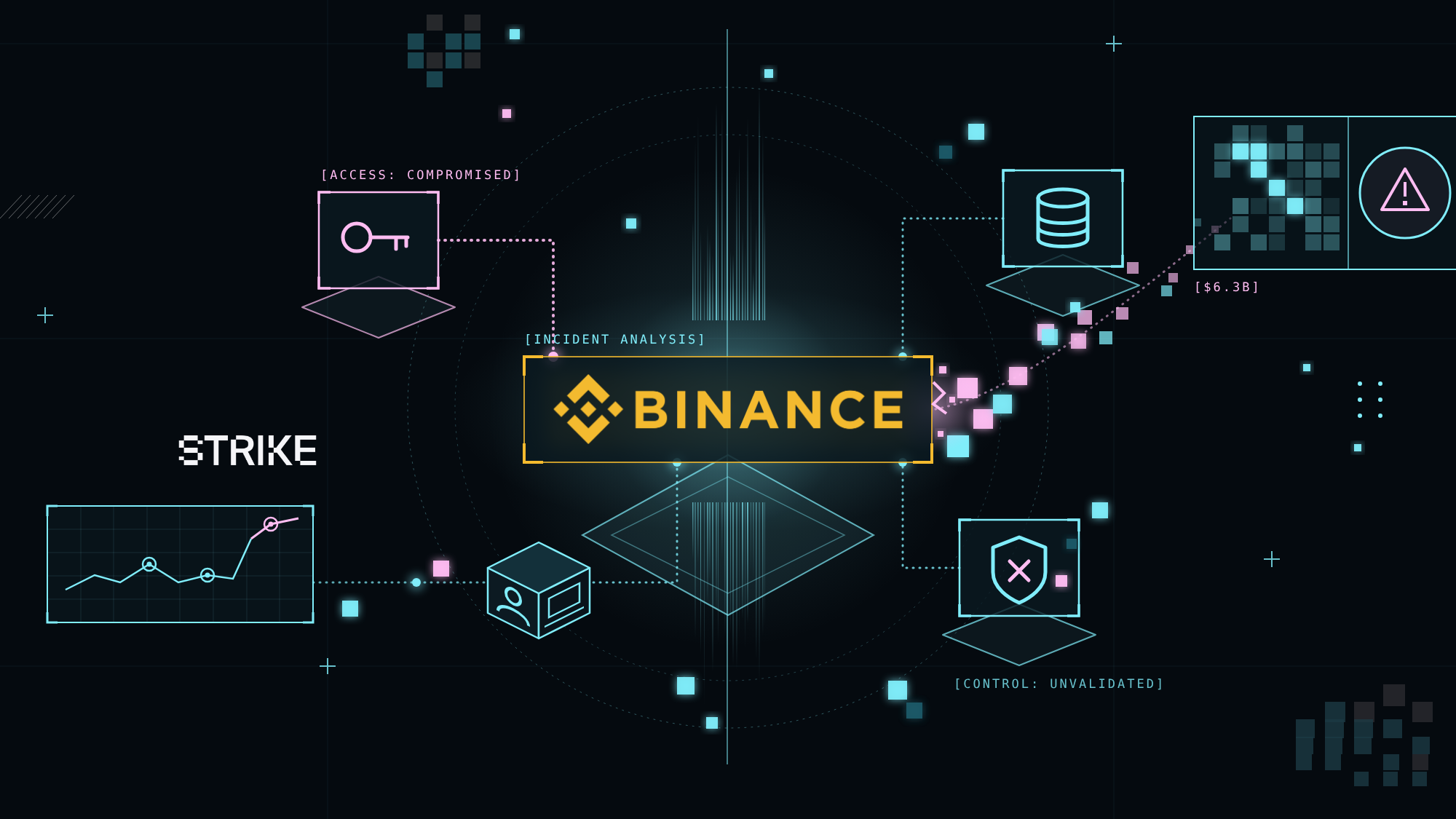
On October 29, 2026, Binance, one of the world's largest cryptocurrency exchanges, suffered a cyberattack involving approximately $6.3 billion in digital assets, according to the company.
Binance temporarily suspended withdrawals, coordinated efforts to freeze some of the affected funds, and committed to covering its users' losses. In its November 3 update, the company reported that approximately $2.85 billion had been frozen or intercepted.
Initial reports pointed to a compromised laptop belonging to a DevOps engineer. However, Binance's preliminary report, published on November 3, revealed that the intrusion had begun months earlier and involved multiple stages in which devices and internal access were compromised.
Although some aspects of the attack remain under investigation, the incident highlights a challenge that extends far beyond cryptocurrency platforms: protecting critical operations that depend on interconnected systems, identities, and services.
Why This Incident Matters for Latin America
The growth of the cryptocurrency ecosystem in Latin America has increased the importance of platforms that custody assets and process digital transactions.
According to Chainalysis' 2025 Geography of Cryptocurrency Report, 64% of cryptocurrency activity in the region takes place through centralized exchanges. The same report indicates that the value of cryptocurrency received grew 63% year over year during the 12-month period ending in June 2025.
These figures illustrate the growing role of centralized platforms in the region's financial ecosystem. Their security affects more than the technology they operate: it also influences service availability, asset protection, and user trust.
The financial impact of cyber incidents is another important consideration. According to IBM's 2026 Cost of a Data Breach Report, the average cost of a data breach among the Latin American organizations studied reached $4.65 million.
While a data breach is not directly comparable to the theft of digital assets, both types of incidents can have consequences that extend well beyond the technical response.
For banks, fintechs, and payment providers, securing financial operations also means protecting business continuity and maintaining customer trust.
Risk Doesn't Always Lie Within a Single System
A financial institution may have security controls in place across its applications, infrastructure, devices, and internal services. However, assessing each component independently doesn't always reveal the risks created by their interactions.
Authorized access to a development environment, for example, may be properly configured for a specific purpose. The same applies to a service account that needs to communicate with other applications or execute certain processes.
The challenge arises when those permissions can be used in unintended ways.
A compromised credential may have limited privileges, but it can also provide access to additional resources if excessive permissions or insufficiently restricted trust relationships exist.
That's why reviewing configurations and permissions alone isn't enough. Security teams also need to understand what actions those permissions could enable and which controls are in place to limit their consequences.
It's not just about protecting individual systems. It's about verifying that compromising one system cannot provide a path to critical operations.
Three Lessons for Banks and Fintechs
The Binance incident highlights three security considerations that are particularly relevant to financial organizations operating complex infrastructures.
1. Evaluating Privileges Also Means Understanding Their Reach
The principle of least privilege states that every user, application, or service should have only the permissions necessary to perform its intended function.
However, assigning appropriate permissions is only part of the process.
It's equally important to assess what could happen if one of those identities were compromised. Which resources could it access? Could it modify configurations, retrieve sensitive information, or perform actions that affect other services?
This analysis is particularly important in environments with service accounts, automated processes, and multiple integrations.
The goal is to reduce the likelihood that compromised access could lead to consequences beyond its intended scope.
2. Detecting Vulnerabilities Is Not the Same as Validating Their Impact
Vulnerability scanning and configuration reviews are essential for identifying security risks. But discovering a weakness doesn't always establish whether it can be exploited or what its actual impact would be.
Offensive security validation provides additional insight by testing attack scenarios within an authorized scope.
This helps organizations verify whether specific vulnerabilities are exploitable, collect evidence of their impact, and distinguish the risks that require immediate attention.
For organizations managing numerous applications and services, this distinction matters. Not every finding represents the same level of exposure or carries the same business consequences.
Prioritizing vulnerabilities based solely on severity can overlook the context in which they exist and the assets they could affect.
3. Critical Systems Need Controls That Limit the Impact of a Compromise
Banks and fintechs rely on systems that process payments, authorize transfers, manage accounts, and perform other sensitive operations.
Protecting access to these components is essential, but organizations also need mechanisms that reduce the consequences of a potential compromise.
Segregation of duties, authorization limits, independent verification, and containment mechanisms help prevent a single identity or service from having unrestricted control over critical operations.
These controls should be reviewed as processes evolve, new integrations are introduced, or operational requirements change.
The security of a financial operation should not depend entirely on every preceding access point remaining secure.
Security Is Also Measured by Its Ability to Limit Impact
The Binance incident illustrates that the consequences of a cyberattack extend beyond the value of the assets compromised.
Service interruptions, containment measures, system recovery, and the need to rebuild user trust are all part of the response.
For a financial institution, these factors can directly affect business continuity.
That's why assessing exposure requires considering both existing vulnerabilities and the business processes and assets they could affect.
It also means recognizing that the attack surface is constantly changing. New applications, infrastructure modifications, integrations, and permission updates can introduce risks that were not present during a previous assessment.
In this context, recurring security validation complements preventive measures with evidence about the security of the assets being tested.
From Risk Identification to Continuous Validation
At Strike, we address this challenge through a continuous hybrid validation model that combines AI-powered offensive testing with the expertise of security professionals.
Through Threat Emulations, organizations can run recurring offensive tests across applications and infrastructure, validate vulnerabilities through exploitation evidence, and obtain actionable insights to prioritize remediation.
The goal is to help security teams focus their efforts on verified risks while maintaining an up-to-date view of their exposure.
The Binance attack is still under investigation, and it would be inaccurate to claim that any specific security measure could have prevented it.
But the incident offers a lesson that applies to any financial organization: security is not just about preventing initial access. It's also about limiting what can happen when that access is compromised.
Sources and Further Reading
- Binance — Preliminary Report on the October 29, 2026 Incident
- Chainalysis — 2025 Geography of Cryptocurrency: Latin America
- IBM — 2026 Cost of a Data Breach Report, Latin America

Get offensive security insights, straight to your inbox
Subscribe to Strike’s newsletter for real-world strategies, threat intel, and expert takes on staying secure in an evolving landscape.