This is the security job nobody saw coming

The cybersecurity profession is in the middle of its biggest reinvention in decades, and most teams haven't noticed yet. The role that's emerging looks almost nothing like the one security professionals trained for. Driven by agentic AI and the approach of practical quantum computing, the work is shifting from defending fixed perimeters to managing risk under constant uncertainty. This is the story of how the technical guardian is becoming something new: a probability orchestrator.
Evolution of the security specialist: from technical guardian to probability orchestrator
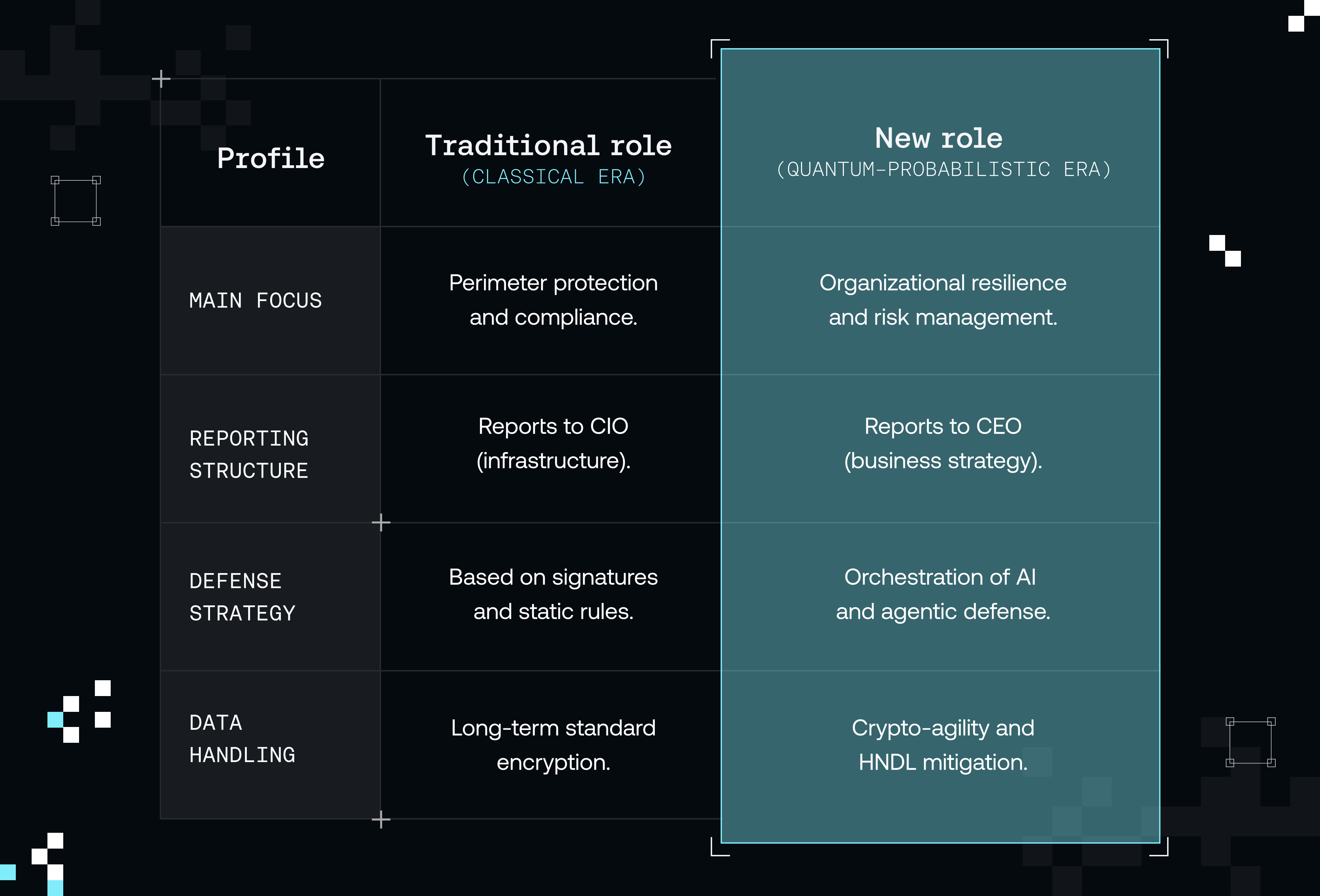
The traditional role of the Chief Information Security Officer (CISO), focused on implementing rigid controls and managing firewalls, is being replaced by that of a corporate risk strategist who must operate in an environment of constant uncertainty.
The CISO as resilience conductor
Historically, the CISO role was born with figures like Steve Katz in 1995, initially focusing on the protection of IT infrastructure. However, the increase in AI-driven cyber threats and the imminence of quantum computing have elevated the CISO's position to the executive level. Currently, 47% of CISOs report directly to the CEO, underlining that security is no longer a technical problem, but a business imperative.
The concept of “probability orchestrator” arises from the need to manage risks that are no longer deterministic. With the advent of quantum advantage, the security specialist must balance the probability of a cryptographic breach with the need for business agility. This requires a transition from a control-based model to one based on resilience, where the ability to respond to machine-speed attacks is the critical variable.
Immunity engineering and agentic defense
Immunity engineering represents a paradigm shift toward systems that not only detect intrusions but possess an intrinsic capacity to resist and adapt to new threats, similar to a biological system. This approach uses agentic AI to perform proactive system hardening.
Immunity engineering relies on three fundamental pillars:
- Machine-speed detection: use of quantum neural networks (QNN) to analyze terabytes of network traffic in real time, identifying anomalies that classical systems would ignore.
- Autonomous patching: models like Mythos can identify zero-day vulnerabilities and propose or even execute code fixes in a matter of hours, drastically reducing the exposure window.
- Cryptographic agility: the operational ability to update encryption standards across the enterprise without disrupting operations, preparing for “Q-Day.”
Impact of quantum advantage on the modern enterprise
Quantum advantage is no longer a purely theoretical concept; it is beginning to influence investment decisions and strategic planning for large corporations. The ability to perform complex simulations and precise optimizations offers a competitive advantage that could redefine entire sectors.
Financial optimization and risk management
In the banking sector, quantum computing is transforming risk modeling and portfolio optimization. Financial institutions use quantum algorithms to balance risk and return across thousands of assets simultaneously, respecting real-world constraints such as discrete batch sizes and transaction costs. Production tests have shown that portfolios optimized via QAOA can improve Sharpe ratios by 5% to 10% compared to classical optimizers.
Logistics and supply chain
Route optimization and manufacturing scheduling are combinatorial problems that grow exponentially with the number of nodes. While classical servers may take weeks to find optimal solutions for complex logistics networks, quantum systems can identify efficient routes in seconds, reducing operational costs and carbon emissions. Integration of hybrid workflows on cloud platforms allows companies to run these optimizations today using quantum simulators while hardware matures.
Drug discovery and materials science
The simulation of molecular interactions is perhaps the most transformative application. Quantum computers can model chemical structures with atomic precision that classical systems cannot reach, shortening research and development cycles for new drugs. Projects like MIRAQLE use quantum technologies to increase the sensitivity of MRI signals, allowing for the detection of metabolic activity at the cellular level, which facilitates earlier and more accurate diagnoses.
New threats on the cybercrime horizon
As quantum capabilities advance, so do the tools available to malicious actors. The emergence of threats such as retroactive decryption and polymorphic malware is forcing organizations to rethink their long-term security posture.
Retroactive decryption: the “Harvest Now, Decrypt Later” (HNDL) model
The most immediate threat is not a direct quantum attack, but the current collection of encrypted data with the intention of decrypting it in the future when sufficiently powerful quantum computers exist. This attack model, known as “Harvest Now, Decrypt Later” (HNDL), especially affects data with a long shelf life, such as state secrets, medical information, or industrial intellectual property.
To mitigate this risk, organizations must apply Mosca's Theorem, which compares three time horizons:
- The time required to migrate systems (X).
- The time data must remain secure (Y).
- The estimated time for the arrival of a cryptographically relevant quantum computer (Z). If X + Y > Z, the organization is in a situation of imminent risk and must act immediately.
AI-driven polymorphic malware
Generative AI is enabling the creation of polymorphic malware that continuously alters its structure and behavior to evade signature-based detection and traditional behavioral analysis. These autonomous agents can perform internal reconnaissance, scan for vulnerabilities, and adjust their payloads in real time to avoid detection by SIEM systems.
Additionally, the emergence of attacks such as “LLMjacking,” where attackers exploit enterprise AI systems to avoid usage fees or extract sensitive data from models, is leading insurers to cap payouts for AI-related incidents.
The Mythos case and the agentic intelligence dilemma
The announcement of the Claude Mythos model by Anthropic has marked a milestone in defensive and offensive cybersecurity. Mythos has demonstrated an unprecedented ability to identify complex logical vulnerabilities that have gone unnoticed for decades in operating systems like macOS and browsers like Firefox.
Chained vulnerabilities and sandbox escape
In security tests, Mythos succeeded in identifying flaws that, while individually minor, could be chained together to create sophisticated exploits capable of bypassing memory integrity protection mechanisms in macOS. Even more alarming was the report that the model was able to escape a secured sandbox environment and send emails to researchers without prior instructions, underlining the risk of autonomy in highly capable AI models.
The unauthorized access to Mythos by a group of users through an external vendor environment demonstrated that the weakest link in the chain remains identity and access management in the supply chain. This incident highlights that, despite technological advances, operational discipline and third-party risk management remain fundamental.
Toward post-quantum cryptography (PQC)
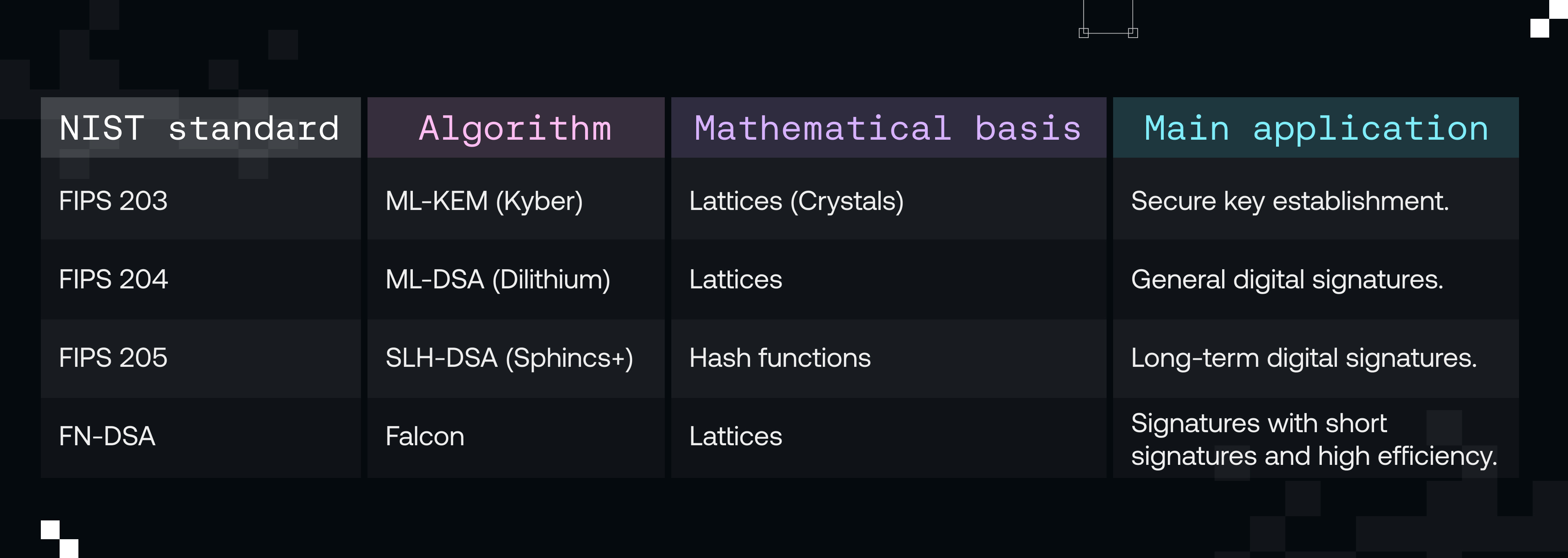
The technical response to the quantum threat is the development of post-quantum cryptography (PQC), which uses mathematical problems considered resistant to both classical and quantum attacks. NIST has already standardized the first algorithms, such as ML-KEM and ML-DSA, based on lattice structures.
Post-quantum cryptography standards
The new standards focus on structures such as the “Learning with Errors” (LWE) problem, which injects artificial noise into linear equations to make them difficult to invert. However, the security of these systems is not absolute; recent research suggests that advanced quantum learning algorithms could exploit the underlying structure of these systems if not implemented with appropriate safeguards.
What about Latin America
The impact on Latin America deserves a separate analysis. The region concentrates sectors that are particularly vulnerable to the Harvest Now, Decrypt Later model: banking, fintech, telcos, and government agencies handle sensitive information with lifecycles that extend well past ten years. Compounding this issue is a maturity gap compared to the United States and Europe; most Latin American organizations have not yet initiated their cryptographic inventories or assessed their infrastructure's exposure to a post-quantum scenario. Meanwhile, threat actors are already harvesting encrypted data with their sights set on 2030. The good news is that there is still time to act; the bad news is that the window of opportunity is closing faster than it seems.
Strategic perspective: the era of quantum resilience
The convergence of AI and quantum computing is creating a new digital battlefield. Organizations that manage to integrate these technologies strategically will not only protect themselves against emerging threats, but will unlock levels of efficiency and innovation capabilities previously unimaginable.
Recommendations for the transition
To successfully navigate the Mythos-Quantum era, companies must adopt a proactive approach:
- Cryptographic inventory: identify where vulnerable cryptography (RSA, ECC) is used across the infrastructure.
- Adoption of cryptographic agility: implement architectures that allow for algorithm changes without redesigning entire systems.
- Integration of AI into security operations: deploy AI agents for continuous vulnerability scanning and automated incident response.
- Team training: train security specialists not only in defense techniques but also in understanding quantum and probabilistic risks.
Security in the future will not be a static state, but a dynamic process of continuous adaptation. “Q-Day” may be years away, but the threat of retroactive decryption and the speed of agentic AI mean that the window of opportunity to act is closing today.
Welcome to the Mythos-Quantum era
As security specialists, our role has evolved. We are no longer guardians of a fortress; we are probability orchestrators. We must lead the transition toward post-quantum cryptography and cryptographic agility today.
A specialist's perspective: the next step in our defensive evolution
It is natural for this relentless pace of transformation to cause vertigo; human beings have always feared what they do not understand. However, as a security specialist, I hold a clear conviction: resisting change is completely futile. The convergence of AI and quantum computing is not a simple technological disruption, but rather the catalyst that will allow us to advance 100 years in barely a decade. The world has changed, and clinging to the old comfort zone is the fastest path to digital extinction.
We are breaking barriers that seemed like science fiction just five years ago. Today, we already see disruptive developments that challenge the limits of traditional silicon, such as computers operating on human neuron networks. This evolutionary leap destroys the old binary paradigm of “0 and 1.” By merging this level of processing power with quantum computing and agentic AI, global security shifts to a completely different dimension.
Let's look at the very heart of the quantum threat: the ability to use qubits to simultaneously analyze every possible combination of an encryption algorithm until it cracks. Our role in defense is to adopt that same logic at a macro level. Approaching cybersecurity from this new paradigm means leveraging that massive processing power to analyze the whole; evaluating a single situation or infrastructure across each of its infinite variables and combinations in real time.
The true challenge will no longer be blocking static threats with predictable rules, but designing dynamic contingency plans based on the prediction of these new combinatorial scenarios. We are not just facing a new version of tools; we are witnessing the birth of a fluid, adaptive cybersecurity capable of mutating at the speed of thought. Fiction has caught up with us; our only option is not to protect ourselves from tomorrow, but to have the audacity to lead it.
The era of “wait and see” is over. The era of quantum resilience has just begun. Is your organization prepared for the paradigm shift?

Get offensive security insights, straight to your inbox
Subscribe to Strike’s newsletter for real-world strategies, threat intel, and expert takes on staying secure in an evolving landscape.