
What Is Ethical Hacking?
Ethical hacking is the practice of using the same techniques as a real attacker — with explicit permission from the owner of the systems — to find and fix weaknesses before someone abuses them. Same tools, same mindset, opposite intent, and a written agreement that defines exactly where the boundaries are.


Who partners with ethical hackers?
Companies whose product is the business, where a single broken access-control check can expose every customer's data at once.
Regulated teams in banking, fintech and insurance that have to show a supervisor real adversarial testing, not a self-assessment questionnaire.
Engineering organizations that want the attacker's perspective early, while a design decision is still cheap to change.
[ HOW IT IS BOUGHT ]
Penetration test, bug bounty or red team?
Ethical hacking is the practice. These are the three ways organizations actually buy it, and they answer different questions — which is why mature programs run more than one.
A practical sequence: scoped testing first to fix what is provably exploitable, continuous coverage so it stays fixed, then a red team exercise once you want to test whether anyone would notice an attacker at all.
[ WHO IS WHO ]
White hat, grey hat, black hat
The hats are shorthand for one variable: consent. The techniques are largely the same in all three cases, which is exactly why authorization is the only thing that reliably distinguishes them.
White hat
Works with written authorization and reports everything found to the owner, including the findings nobody wanted to hear about. This is what the industry means by ethical hacking, and it is what you are buying in a penetration test.
Grey hat
Probes systems without permission but discloses what they find instead of exploiting it. Often well intentioned, and still unlawful in most jurisdictions — good faith is not a legal defence, which is why responsible disclosure programs exist.
Black hat
Acts without authorization for financial, personal or political gain. Same techniques as the other two, and increasingly the same automation. The difference is consent and what happens to the findings.
What ethical hackers actually work on
Attack surface mapping. Finding what is exposed before testing it: domains, IP ranges, services, cloud assets, leaked credentials and the systems nobody remembers deploying.
Authorization and access control. Whether one user can read another user's data, whether a customer can reach another tenant, and whether a low-privilege account can do a high-privilege thing.
Injection and input handling. Whether data supplied by a user is ever treated as instructions — in a database query, a template, a command, or a downstream service.
Identity and credentials. Password reset flows, session handling, multi-factor bypasses, token validation, and credential reuse across environments.
Cloud and infrastructure configuration. Over-permissive IAM roles, exposed storage, metadata services, and managed services left open by default.
Business logic. The attacks that break no technical rule at all: replaying a discount, skipping a step in a payment flow, or manipulating a limit the code never checked twice.
[ CAREER PATH ]
How to become an ethical hacker
There is no single route in, but the people who make it tend to build the same foundation before they touch an exploit.
1. Fundamentals first. Networking and TCP/IP, Linux from the command line, how HTTP and TLS actually behave, and at least one scripting language — usually Python. Almost everyone who stalls out later skipped this part.
2. Learn how applications are built. Ethical hacking is mostly about finding the gap between what a developer intended and what the system permits. That gap is much easier to see if you have written and deployed software yourself.
3. Practice legally and constantly. Deliberately vulnerable labs, capture-the-flag competitions and public bug bounty programs give you real targets with real permission. Volume of hours on target is what separates candidates.
4. Get a hands-on certification. Practical exams that require you to compromise machines in a lab and write a professional report are the ones hiring teams respect. Multiple-choice credentials help with HR filters and procurement, not with credibility inside a security team.
5. Specialize. Web and API, Active Directory and internal networks, cloud, mobile, or detection evasion for red team work. Generalists get hired; specialists get requested by name.
6. Learn to write. The finding that gets fixed is the one an engineer can reproduce and a manager can prioritize. Reporting is the skill that most often decides who becomes senior.
Strike recruits certified offensive security professionals into its community of Strikers — see Strikers and current open roles.
[ FAQ ]
Ethical hacking FAQ
Is ethical hacking legal?
It is legal when it is authorized, and the authorization document is what makes it so — not good intentions. A signed scope naming the systems, the permitted techniques and the testing windows is what separates an ethical hacker from a defendant. Scope creep matters too: testing something outside the agreed boundary can put an otherwise lawful engagement outside its own protection.
Do ethical hackers need permission for every test?
Yes, and the permission has to come from someone who can actually grant it. That is a recurring problem with cloud and SaaS assets: the company may own the data but not the infrastructure, so testing a third-party platform can require the provider's consent as well as the customer's.
Is ethical hacking the same as penetration testing?
Not quite. Ethical hacking is the practice; a penetration test is one scoped, time-bound engagement inside it, with an agreed target, a methodology and a deliverable. Bug bounties and red team exercises are other ways of buying the same practice. See what penetration testing is for the engagement-level detail.
What certifications do ethical hackers need?
Hands-on, exam-in-a-lab certifications carry far more weight with hiring teams than multiple-choice ones. The OSCP is the common baseline for offensive roles, with specialist follow-ons for web, Active Directory and evasion. Multiple-choice credentials still open doors in procurement and HR filters, but nobody in the field treats them as proof of skill.
Can AI replace ethical hackers?
It replaces the repetitive part of the work, not the judgement. Machines are better at breadth — enumerating assets, replaying known attack paths, doing it again after every deployment. People are still better at chaining findings, abusing business logic and knowing which of a hundred issues would actually hurt this particular company. Strike is built to use both rather than pick one.
How do companies hire ethical hackers?
Three routes, usually combined: employ them in-house for continuous internal work, buy scoped engagements from a provider, or open a bug bounty for breadth from unknown researchers. Most teams under roughly 500 people find a provider more practical than building the function internally — see penetration testing services.
ETHICAL HACKING
More than a test. A strategic layer for real security.
Our AI is powered by a proprietary data layer built from thousands of hours of pentesting and real-world validations. Strike combines autonomous execution and expert human validation to uncover complex risks, reduce noise, and prioritize actionable findings.

In-depth continuous testing
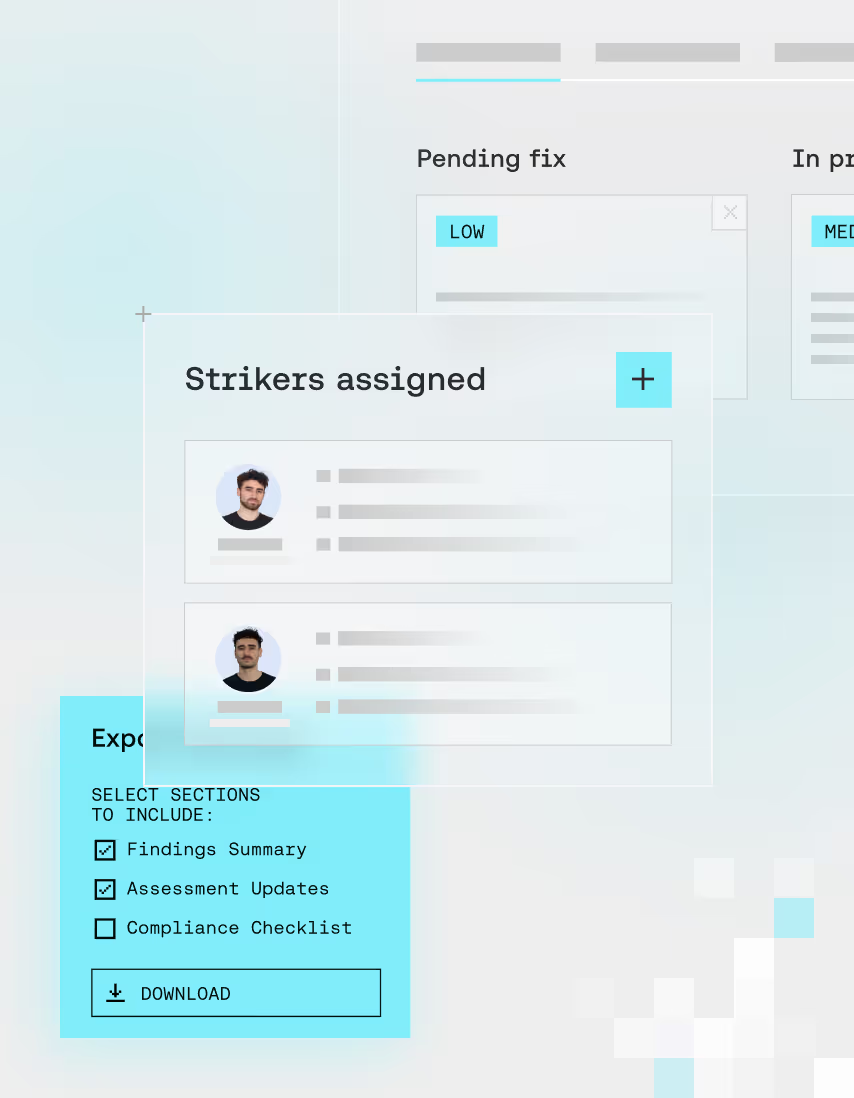
Strikers uncover high-impact vulnerabilities across multi-technology environments (web apps, APIs, mobile, cloud, and more).

AI-led retesting on-demand
Validate fixes without waiting for the next testing cycle. Retesting availability depends on the subscribed scope.

Real-time fixing
AI agents guide your team step-by-step through remediation to accelerate resolution.

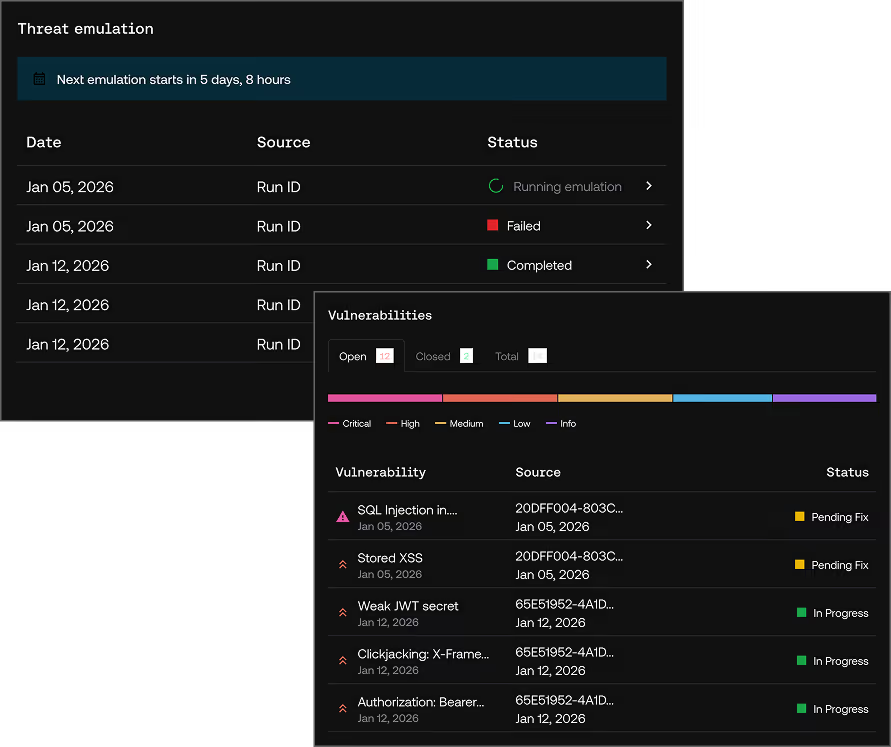
Step-by-step Threat emulation creation
Easily scope, launch, and track your Threat emulation with full transparency.

Human triaging & peer review
Expert human validation before customer delivery, for accuracy and impact.

Full visibility
Track every finding with complete transparency through security expert work logs and real-time notifications.

Seamless integrations
Connect directly with Slack, Teams and Jira to streamline collaboration with your security and development teams.

Vulnerability Manager
Visualize, manage, and retest vulnerabilities in one platform, with full context on severity, sources, and remediation.

Reporting that supports audit and compliance programs
Generate up-to-date reports with evidence per finding to support your PCI DSS, HIPAA, ISO 27001 and SOC 2 programs. Strike does not issue SOC 2 reports, ISO certificates or PCI DSS attestations.

Ongoing partnership
Weekly check-ins with a dedicated Customer Success Manager, plus personalized onboarding and strategic planning.
What separates an ethical hacker from an attacker is not skill or tooling. It is authorization, agreed scope, and what happens to the findings afterwards.

Trusted by security teams that lead






Human expertise.
AI power.
Superior security.
Whether you’re scaling fast, closing enterprise deals, or just tired of noisy reports, we’ll help you build a security stack that moves faster than your threats.
