
Penetration testing services built for continuous delivery
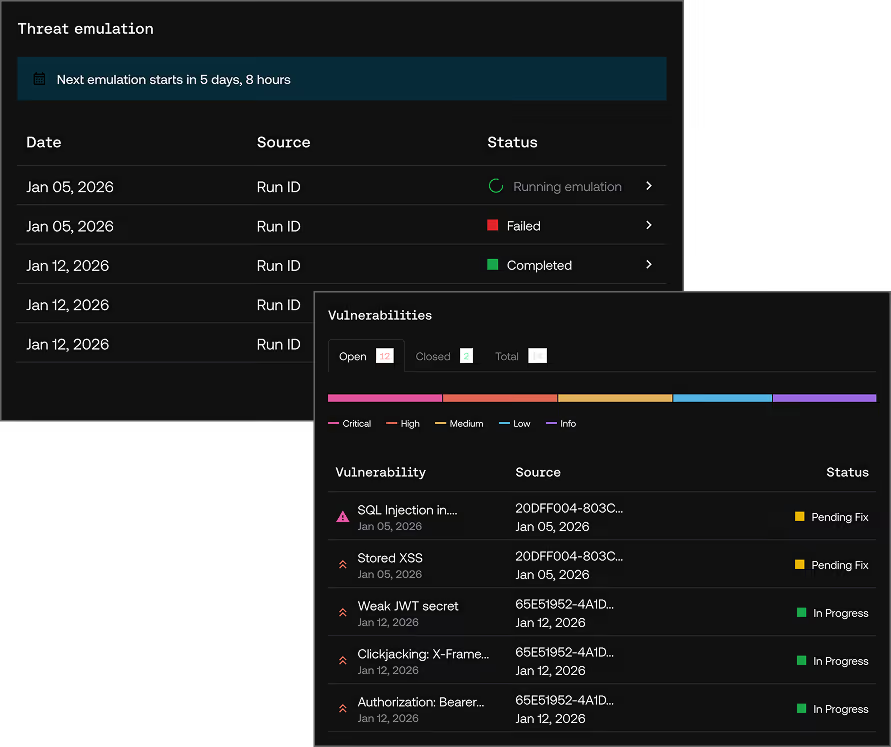
Penetration testing services simulate real attacks against your systems to find and prove exploitable weaknesses before an attacker reaches them. Strike delivers them as a continuous subscription rather than a once-a-year project: AI-led execution, expert human validation before customer delivery, and evidence that supports audit and compliance programs across web, API, cloud and infrastructure.


Built for teams that outgrew the annual pentest
Security leads tired of renegotiating a statement of work every time something needs to be retested.
Companies whose attack surface grows faster than a yearly budget cycle can be made to cover it.
Teams that need one provider across web, API, cloud and infrastructure, producing evidence that supports audit and compliance programs.
What a penetration testing service should actually deliver
Most penetration testing services are still sold the way consultancies sold them twenty years ago: you scope an engagement, wait weeks for a slot, get two weeks of testing and a PDF, and then run blind until next year's budget cycle. Strike sells the same expertise as a subscription that never stops — because the systems being tested never stop changing either. Below is what that covers and how to pick the right entry point.
Scope starts from assets, not from days. We map what you actually expose — domains and subdomains, the APIs behind your front ends, cloud accounts, external infrastructure, the mobile backends nobody remembered to list — and then agree what is in and out. That inventory is the scope, and because it is continuously monitored, an asset that appears next month is picked up rather than quietly falling outside a document signed in January.
Depth is set separately from breadth. A public marketing site and a payments API do not need the same level of attention, so testing effort concentrates where the business impact is: authenticated flows, privilege boundaries, money movement, and anything holding customer data.
External web applications and the APIs behind them, REST and GraphQL alike, including authenticated flows and the boundaries that are supposed to keep tenants apart. Cloud accounts and their configuration, identity and permission models. External infrastructure, exposed services and the network edge. Mobile backends. Internal systems where the engagement calls for it.
The surfaces that get skipped are usually the ones that matter: a staging environment left reachable from the internet, an internal admin panel sitting on a public subdomain, an API version that was supposed to be deprecated two quarters ago. Continuous discovery is what surfaces those, and it runs whether or not anyone remembered to write them into a scope document.
A fixed-scope engagement makes sense when the thing being tested is fixed. Nothing in a modern stack is: you ship weekly, dependencies update themselves, infrastructure moves, and permissions drift. The annual model was designed for a world of quarterly releases and it produces a predictable failure — a clean report in March and an unvalidated environment from April onwards.
A subscription changes the economics as well as the coverage. Instead of renegotiating a statement of work every time you want something retested, retesting availability depends on the subscribed scope and each retest is tied to the finding it closes. Instead of paying separately for each new application, the surface is covered as it grows. And instead of one report a year, you accumulate a dated evidence trail, which is what supports an audit and compliance programme.
Cybersecurity services and penetration testing services: what each one covers
A cybersecurity service covers prevention, detection and response across the whole surface. Penetration testing is the part that checks, with permission and under controlled conditions, whether those controls hold up against a real attack. A buyer evaluating cybersecurity services almost always needs both layers: the one that keeps the operation running and the one that verifies it.
Penetration testing services, answered
What does a penetration testing service include?
Scoping and asset discovery, the testing itself, expert human validation before customer delivery, a report with severities and reproduction steps, remediation guidance, and a retest confirming the fix holds. With Strike all of that is continuous, according to the subscribed scope, rather than a sequence of separately budgeted phases.
How is penetration testing priced?
Traditional providers price by tester-days, which is why a scope negotiation is really a haggle over how long someone will look. Strike prices by the surface covered, as a subscription. That means the cost is predictable and does not go up because you asked for a fix to be retested.
How long does a penetration test take?
A conventional engagement runs two to four weeks of testing after a scoping period that is often longer than the test. Three separate clocks apply at Strike and they should not be added together: platform setup takes under 5 minutes once the target information and access are ready; the start of execution depends on scope authorisation and access; the first validated finding arrives in approximately 1 hour and the curated set in 1-2 hours, on supported scopes.
What do we actually receive?
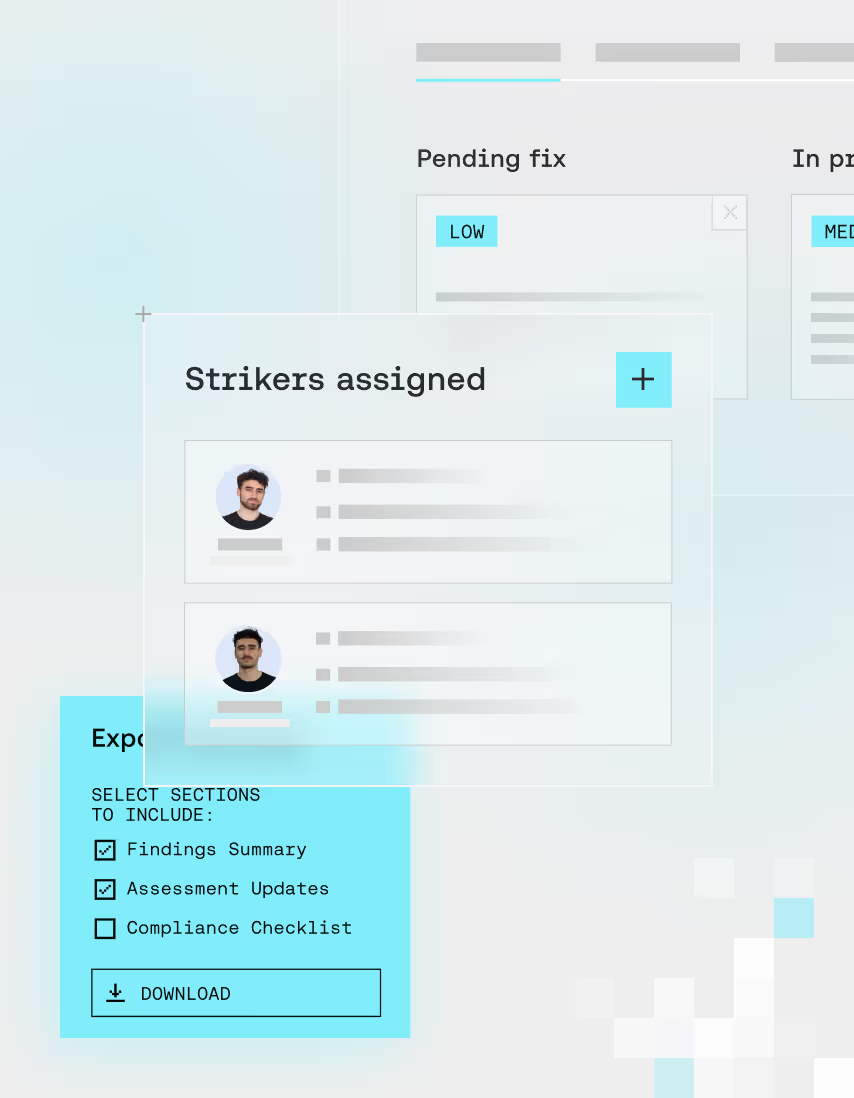
Validated findings in a platform your team can work from, with severity, evidence and reproduction steps; guided remediation; on-demand retesting subject to the subscribed scope; and exportable reports that support audit and compliance programs, which you hand to a customer security review or to your auditor without rewriting them.
Which service is right for us?
If you ship software continuously, start with continuous testing and add web application depth. If you are preparing for an audit, start from the compliance evidence angle. If you want to know whether your detection and response actually work, that is a red team engagement, not a pentest. Most teams end up combining two of the three.
How do we get started?
Book a demo. We map your external surface with you, agree on scope and depth, and get testing running. There is no procurement marathon and no minimum multi-year commitment required to begin.
ALWAYS-ON PLATFORM
More than a test. A strategic layer for real security.
Our AI is powered by a proprietary data layer built from thousands of hours of pentesting and real-world validations. Strike combines autonomous execution and expert human validation to uncover complex risks, reduce noise, and prioritize actionable findings.

In-depth continuous testing
Strikers uncover high-impact vulnerabilities across multi-technology environments (web apps, APIs, mobile, cloud, and more).

AI-led retesting on-demand
Validate fixes without waiting for the next testing cycle. Retesting availability depends on the subscribed scope.

Real-time fixing
AI agents guide your team step-by-step through remediation to accelerate resolution.

Step-by-step Threat emulation creation
Easily scope, launch, and track your Threat emulation with full transparency.

Human triaging & peer review
Expert human validation before customer delivery, for accuracy and impact.

Full visibility
Track every finding with complete transparency through security expert work logs and real-time notifications.

Seamless integrations
Connect directly with Slack, Teams and Jira to streamline collaboration with your security and development teams.

Vulnerability Manager
Visualize, manage, and retest vulnerabilities in one platform, with full context on severity, sources, and remediation.

Reporting that supports audit and compliance programs
Generate up-to-date reports with evidence per finding to support your PCI DSS, HIPAA, ISO 27001 and SOC 2 programs. Strike does not issue SOC 2 reports, ISO certificates or PCI DSS attestations.

Ongoing partnership
Weekly check-ins with a dedicated Customer Success Manager, plus personalized onboarding and strategic planning.
More than an offensive security platform, Strike operates as a continuous validation layer for environments that never stop changing.

Trusted by security teams that lead






Human expertise.
AI power.
Superior security.
Whether you’re scaling fast, closing enterprise deals, or just tired of noisy reports, we’ll help you build a security stack that moves faster than your threats.
