
Cloud penetration testing
Cloud penetration testing attacks the part of the cloud you are responsible for: identity and permissions, exposed storage, workloads, containers, and the pipelines that deploy them. The provider's own infrastructure is not yours to test and testing it is prohibited. Everything you configured on top of it is yours, and that is where the findings are.


For teams who moved fast and configured as they went
Organizations with several cloud accounts, some created by teams that no longer exist, and no single view of who can reach what.
Engineering teams running containers and CI/CD, where the pipeline holds credentials that reach production directly.
Security teams with a posture tool full of misconfiguration findings and no proof of which ones actually chain into access to data.
A posture finding, a host finding, and a path to your data
Cloud security posture tools are good and you should run one. What they produce is a list of deviations from a baseline, ranked by a rule rather than by consequence. A cloud penetration test starts from those same conditions and asks the only question a board cares about: does this chain into access to something that matters, and how far does it go?
These are complements. Posture tooling is how you keep the configuration honest between tests; the test is how you learn which deviations were load-bearing.
What is yours to test, and what is not
Where cloud findings actually come from
Frequently asked questions
Do I need permission from my cloud provider?
For the three major providers, generally no, and this is the single most out-of-date belief in cloud security buying. AWS allows testing of its permitted services without prior approval, though command and control testing needs approval. Microsoft has not required pre-approval since June 2017, subject to its unified rules of engagement. Google states that customers testing their own Cloud Platform infrastructure are not required to contact them. Denial of service testing is prohibited by all three, and each publishes the authoritative current version of its own policy.
What is actually in scope under shared responsibility?
Everything you configured: identity and access policies, storage exposure, network rules and security groups, workloads and containers you run, application code, and the pipelines that deploy all of it. Not in scope: the provider's hypervisor, physical infrastructure, or the internals of a managed service. The practical consequence is that as you adopt more managed services, the proportion of your remaining risk that lives in identity configuration goes up rather than down.
How is cloud penetration testing different from CSPM?
A posture tool compares your configuration to a baseline and returns deviations. A penetration test takes those conditions and tries to reach something. The difference shows up in prioritization: a posture tool cannot tell you that this particular over-permissive role, combined with that particular exposed instance, reaches the customer database, and that is the sentence a remediation plan needs. Run the posture tool continuously; use testing to learn which of its findings were load-bearing.
Does cloud testing cover Kubernetes?
It should, and the scope needs saying out loud because managed and self-hosted clusters differ in what belongs to you. Testing covers RBAC and service account permissions, workload security context, network policy between namespaces, exposed control plane components, image provenance, and — most importantly — what the cloud identity attached to a pod can do once the tester is inside it. That last link is where a container finding becomes an account finding.
What access should we give the testers?
A read-only role for configuration review, plus at least one low-privilege identity to start from for the attack-path work. The read-only role makes the review complete; the low-privilege identity makes the escalation testing realistic. Some teams also ask for an unauthenticated external pass first, which is worth doing and answers a different question — what a stranger reaches — rather than replacing the authenticated work.
How often should cloud environments be tested?
Cloud configuration changes every time infrastructure code is merged, which for most teams is many times a week. An annual test describes an account that no longer exists. The realistic pattern is continuous posture monitoring, testing that runs against changes as they land, and a deeper periodic engagement for the paths that require a human to chain together.
ALWAYS-ON PLATFORM
More than a test. A strategic layer for real security.
Our AI is powered by a proprietary data layer built from thousands of hours of pentesting and real-world validations. Strike combines autonomous execution and expert human validation to uncover complex risks, reduce noise, and prioritize actionable findings.

In-depth continuous testing
Strikers uncover high-impact vulnerabilities across multi-technology environments (web apps, APIs, mobile, cloud, and more).

AI-led retesting on-demand
Validate fixes without waiting for the next testing cycle. Retesting availability depends on the subscribed scope.

Real-time fixing
AI agents guide your team step-by-step through remediation to accelerate resolution.

Step-by-step Threat emulation creation
Easily scope, launch, and track your Threat emulation with full transparency.

Human triaging & peer review
Expert human validation before customer delivery, for accuracy and impact.

Full visibility
Track every finding with complete transparency through security expert work logs and real-time notifications.

Seamless integrations
Connect directly with Slack, Teams and Jira to streamline collaboration with your security and development teams.

Vulnerability Manager
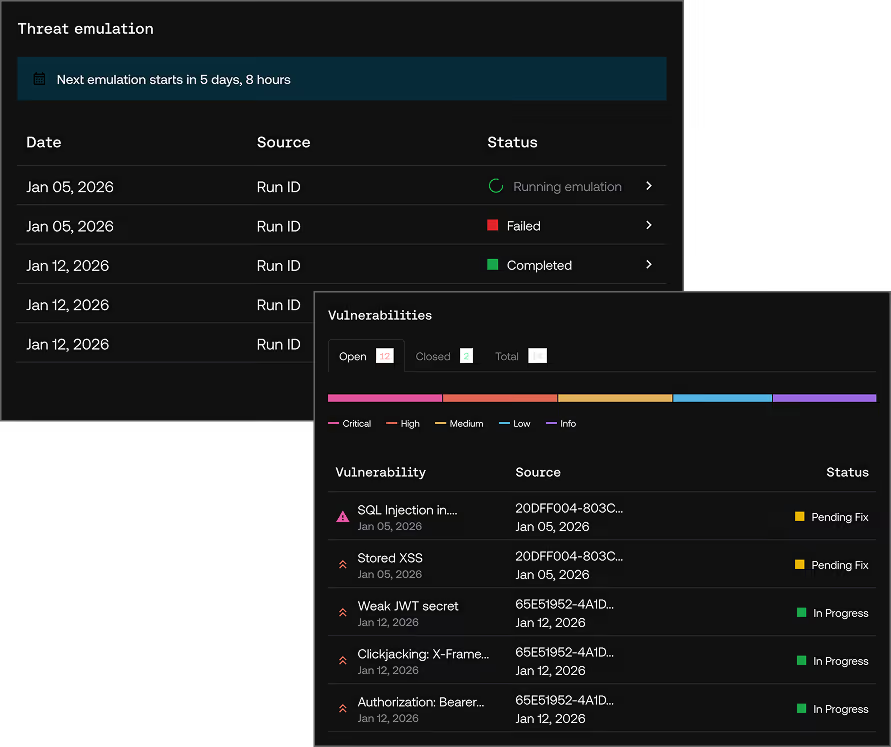
Visualize, manage, and retest vulnerabilities in one platform, with full context on severity, sources, and remediation.

Reporting that supports audit and compliance programs
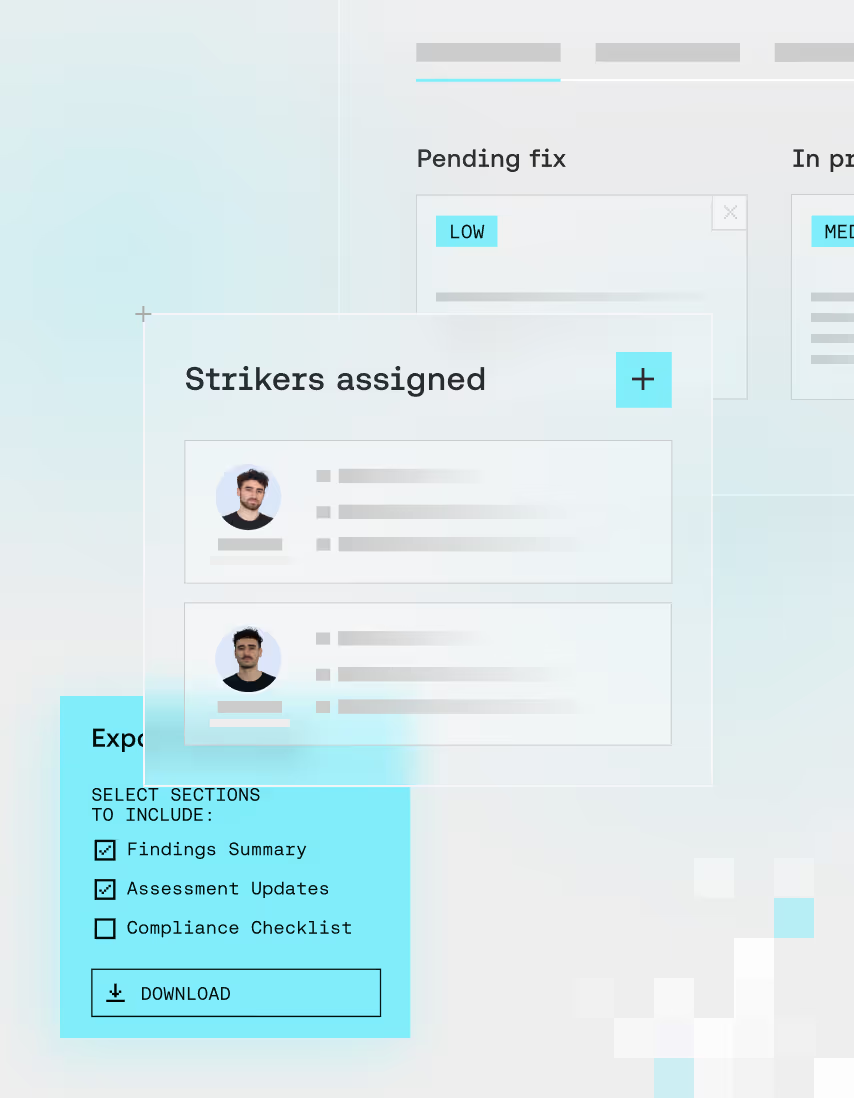
Generate up-to-date reports with evidence per finding to support your PCI DSS, HIPAA, ISO 27001 and SOC 2 programs. Strike does not issue SOC 2 reports, ISO certificates or PCI DSS attestations.

Ongoing partnership
Weekly check-ins with a dedicated Customer Success Manager, plus personalized onboarding and strategic planning.
More than an offensive security platform, Strike operates as a continuous validation layer for environments that never stop changing.

Trusted by security teams that lead






Human expertise.
AI power.
Superior security.
Whether you’re scaling fast, closing enterprise deals, or just tired of noisy reports, we’ll help you build a security stack that moves faster than your threats.
