
External penetration testing
An external penetration test attacks everything your organization exposes to the internet: public IP ranges, VPN and mail gateways, DNS, and every web application or API reachable without being on your network. The difficult part is rarely the attacking. It is knowing what is actually exposed this week, because a perimeter changes faster than the inventory that describes it.

For teams whose internet-facing surface grows without asking permission
Organizations where an engineer can publish a subdomain, a storage bucket or a preview environment without a security review in the way.
Security teams who suspect their asset inventory is a year behind reality and would rather measure the gap than argue about it.
Companies carrying acquisitions, retired brands or old campaign domains that still resolve to something live.
Finding it, mapping it, and proving you can get through it
Three things get sold against each other for the same budget line, and they are not substitutes. A scanner checks known issues on assets you already listed. Attack surface management finds assets you had not listed and tells you they exist. An external penetration test does the discovery and then tries to get in, which is the only one of the three that produces evidence rather than inventory.
The three are complements, not alternatives. The mistake worth avoiding is buying only the first two and reporting the result as though someone had tried to break in.
How discovery actually works
What belongs in an external scope
Frequently asked questions
What is external penetration testing?
Authorized attack simulation against everything your organization exposes to the internet, performed from outside your network with no prior access. It covers discovery of what is exposed, identification of weaknesses on those assets, and exploitation to prove which of them lead somewhere. The output is a set of demonstrated ways in, ranked by what they reach, rather than a catalogue of theoretical issues.
How is external testing different from internal testing?
External testing starts with no access and asks what a stranger can reach and break. Internal testing starts with the assumption that someone is already inside and asks how far they get. They find different classes of problem: external work tends to surface exposure and inventory failures, internal work tends to surface trust, segmentation and directory failures. Programs that run only one are usually surprised by the other.
What should be in an external scope?
Public IP ranges, VPN and remote access, mail and DNS, all internet-reachable web applications and APIs, and cloud-hosted endpoints. The more useful instruction is to let the tester perform discovery first and then agree the scope against what they find, because the assets missing from your list are exactly the ones that have been unmonitored longest.
How often should the perimeter be tested?
More often than most compliance schedules require, because the perimeter changes on the cadence of your deployments rather than on the cadence of your audit. An annual test is a photograph of one day, and it will not contain the subdomain that appeared in March. This is the specific mismatch that continuous testing exists to close.
Is external penetration testing the same as attack surface management?
No, and they work well together. Attack surface management is the discovery and inventory function: it tells you what exists and how exposed it looks. External penetration testing takes that inventory and tries to break it, which is what turns an exposure rating into evidence. Buying only the inventory and reporting it as an assessment is a common and avoidable mistake.
Can external testing be done without disrupting production?
Yes, with the usual precautions: denial-of-service testing excluded by default, destructive actions agreed in advance, an escalation contact available during testing, and fragile systems flagged so they are handled carefully. Most external testing is read-heavy and unremarkable from the outside. The exceptions are worth naming in the rules of engagement rather than discovering live.
ALWAYS-ON PLATFORM
More than a test. A strategic layer for real security.
Our AI is powered by a proprietary data layer built from thousands of hours of pentesting and real-world validations. Strike combines autonomous execution and expert human validation to uncover complex risks, reduce noise, and prioritize actionable findings.

In-depth continuous testing
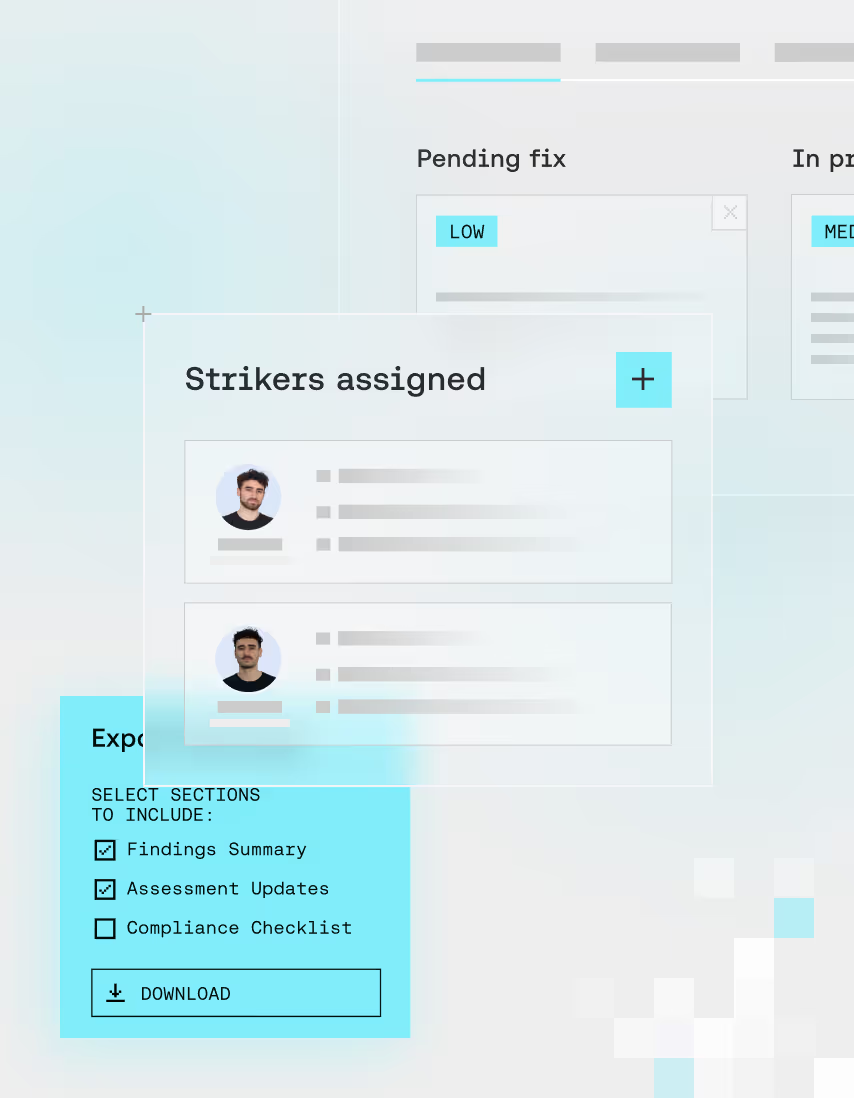
Strikers uncover high-impact vulnerabilities across multi-technology environments (web apps, APIs, mobile, cloud, and more).

AI-led retesting on-demand
Validate fixes without waiting for the next testing cycle. Retesting availability depends on the subscribed scope.

Real-time fixing
AI agents guide your team step-by-step through remediation to accelerate resolution.

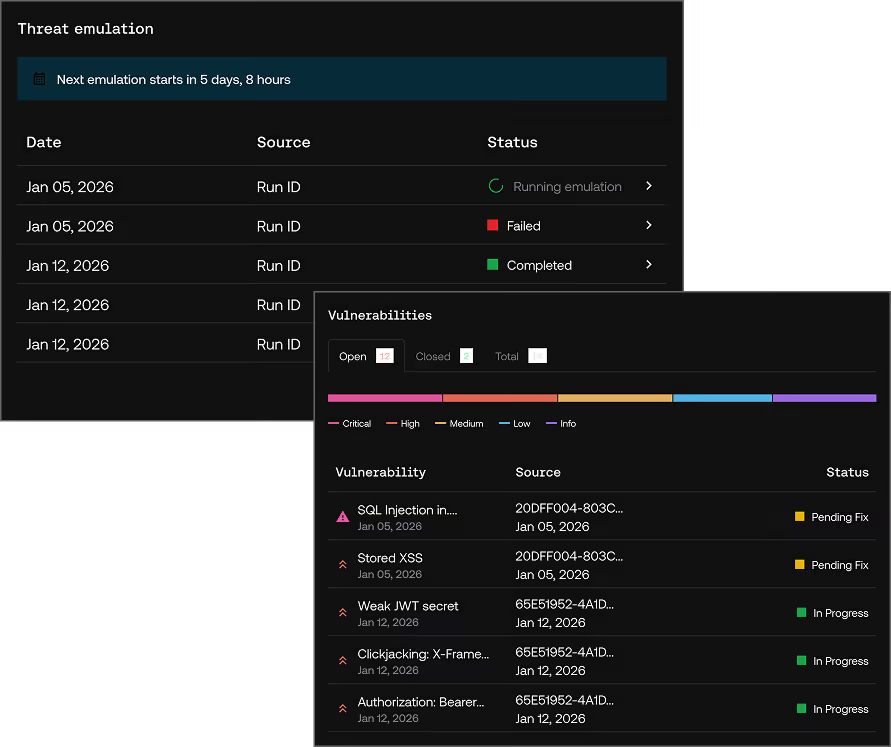
Step-by-step Threat emulation creation
Easily scope, launch, and track your Threat emulation with full transparency.

Human triaging & peer review
Expert human validation before customer delivery, for accuracy and impact.

Full visibility
Track every finding with complete transparency through security expert work logs and real-time notifications.

Seamless integrations
Connect directly with Slack, Teams and Jira to streamline collaboration with your security and development teams.

Vulnerability Manager
Visualize, manage, and retest vulnerabilities in one platform, with full context on severity, sources, and remediation.

Reporting that supports audit and compliance programs
Generate up-to-date reports with evidence per finding to support your PCI DSS, HIPAA, ISO 27001 and SOC 2 programs. Strike does not issue SOC 2 reports, ISO certificates or PCI DSS attestations.

Ongoing partnership
Weekly check-ins with a dedicated Customer Success Manager, plus personalized onboarding and strategic planning.
More than an offensive security platform, Strike operates as a continuous validation layer for environments that never stop changing.

Trusted by security teams that lead






Human expertise.
AI power.
Superior security.
Whether you’re scaling fast, closing enterprise deals, or just tired of noisy reports, we’ll help you build a security stack that moves faster than your threats.
