
Penetration testing evidence for your SOC 2 report
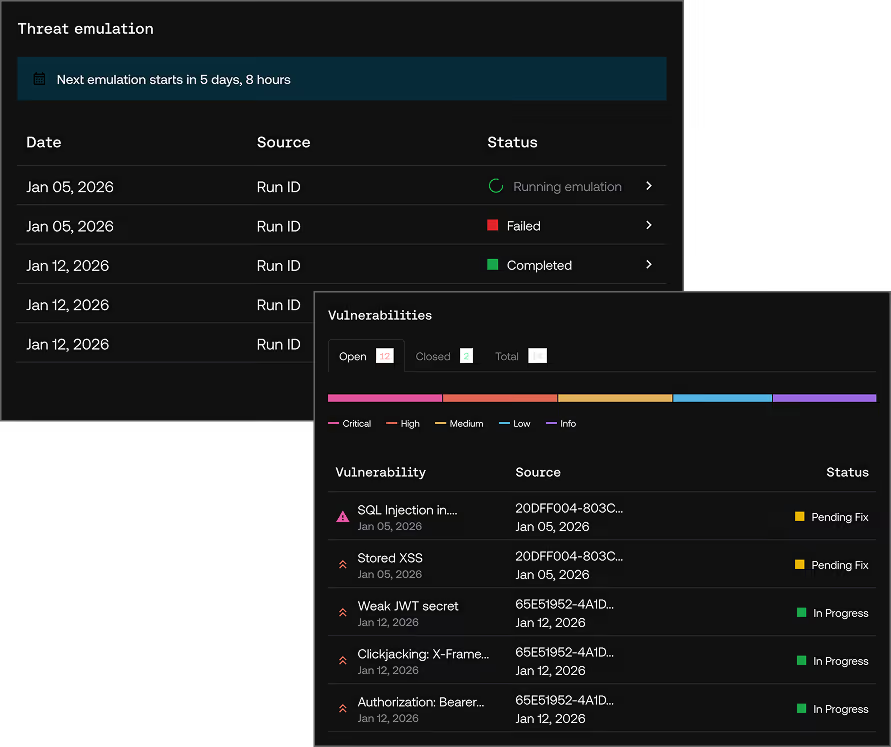
SOC 2 measures your controls against the AICPA Trust Services Criteria, and penetration testing is the technical evidence auditors expect that those controls hold under a real attack. Strike tests continuously with AI-led execution and expert human validation, across your entire observation period. Strike supports the audit; your CPA firm issues the report.

Built for the Type II observation period
SaaS and fintech teams whose enterprise deal is waiting on a report their prospect's procurement team already demanded.
Organisations inside a Type II window that need dated evidence across the whole period, not one report at the edge of it.
Teams that want a single testing programme feeding SOC 2, ISO 27001 and PCI DSS instead of three disconnected engagements.
What SOC 2 asks for — and where penetration testing fits
SOC 2 is not a certification. It is an attestation report, written and signed by a licensed CPA firm, on how your controls map to the AICPA Trust Services Criteria — the 2017 criteria, still current, with their points of focus revised in 2022. Nowhere in those criteria is a penetration test named as a required control. It appears once, as one example among several kinds of evaluation management can run. That single mention is why almost every SOC 2 audit includes one anyway.
A Type I report describes whether your controls are suitably designed on one specific date. A Type II report says whether they operated effectively across an observation period, usually three to twelve months. For a Type I, a recent test report is normally enough. For a Type II the auditor is sampling a window — and a single test dated four weeks before that window opened says nothing about the months that follow it.
CC4.1 — Monitoring activities. Management is expected to run ongoing and separate evaluations confirming that internal control is present and working. The points of focus list the options: internal audit, compliance assessments, vulnerability scans, security assessments and penetration testing. It is a menu, not a mandate — and penetration testing is the item on that menu an auditor recognises fastest.
CC7.1 — Detection. You have to detect configuration changes that introduce new vulnerabilities, and identify newly discovered ones in your components. Scanning satisfies the letter of it. Testing that chains findings into a working exploit is what tells you which of those vulnerabilities actually matters.
Depending on your scope, the access-control criteria in CC6 and the incident criteria in CC7.2 also lean on testing evidence: controls that resist real attempts to bypass them, and anomalies that get detected rather than logged and ignored.
Most SOC 2 programmes do not start with a security goal. They start with an enterprise prospect whose procurement team will not sign without the report. That deadline is what shapes the testing decision: teams book the cheapest test that closes the gap, get a PDF, and find out at the Type II that the auditor wanted evidence across the whole period rather than one dated document.
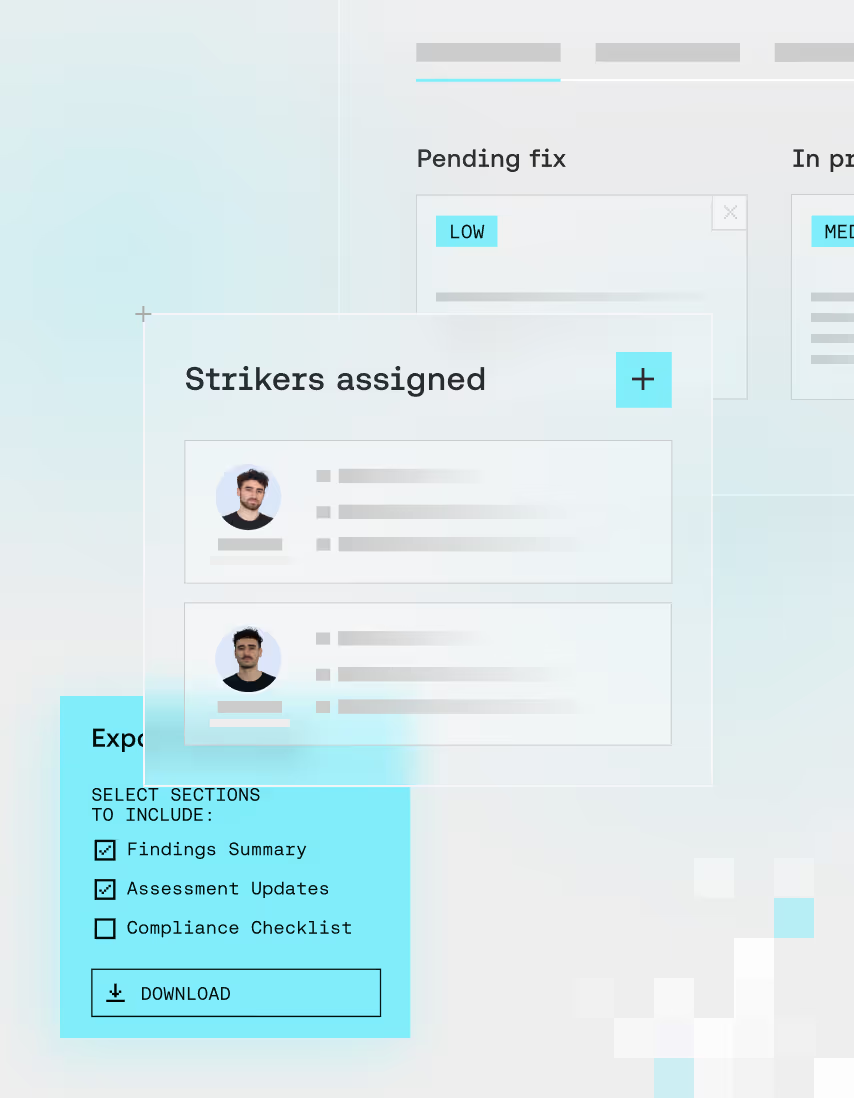
Scope and methodology, the qualifications of the testers, each finding with its severity, the date it was remediated, and evidence that the fix was retested and held. For a Type II, dates matter more than anything else: the auditor is checking that your evidence covers the observation window, not only its edges.
Strike does not issue SOC 2 reports and never will — only a licensed CPA firm can. What Strike delivers is the technical evidence behind them: continuous penetration testing executed by AI with expert human validation before customer delivery, retesting whose availability depends on the subscribed scope, and a dated evidence trail that runs the length of your observation period instead of stopping after one engagement.
Strike-reported metrics on this page: 97% precision / 3% false positives. That is a figure Strike reports about its own platform, not a third-party benchmark; the scope, definition and measurement dates behind it are set out in how Strike measures results.
Does SOC 2 require penetration testing?
Kind of. SOC 2 does not explicitly mandate penetration testing in the written AICPA Trust Services Criteria. However, because criteria like CC4.1 (monitoring activities) and CC7.1 (vulnerability identification) require you to test and monitor controls, auditors almost universally expect an annual third-party penetration test as standard evidence.
Start with what a SOC 2 report is. It is an attestation, written and signed by a licensed CPA firm, on how an organisation's controls line up with the AICPA Trust Services Criteria. It is not a certification and there is no SOC 2 certificate. What you receive is the CPA firm's opinion, the description of the system, and the tests that firm performed.
Where penetration testing sits is a different question from whether it is named. It is commonly accepted as audit evidence. That is a statement about practice rather than about obligation: auditors recognise a test report quickly, buyers reading your report expect to see one, and it is the artefact that most readily shows a control holding under attack. None of that turns it into a named requirement.
What we could not verify, stated plainly. Whether the Trust Services Criteria name penetration testing at criteria level: not found in the public materials reviewed on 29 July 2026. Which specific criteria reference it: not found in the public materials reviewed on 29 July 2026. We are not going to quote criteria numbers we could not read in a public source, and a vendor page that does is worth reading with some caution.
How to use this when the auditor asks. Ask what the request is grounded in — your own control descriptions, or a criterion the auditor can point to. Either way the evidence you produce is the same: scope, method, tester competence, findings with severity, remediation dates, and proof the fix held, with dates falling inside the observation period. Strike supports that programme; it does not issue SOC 2 reports.
Source: AICPA & CIMA, SOC 2 (audit and assurance), accessed 29 July 2026. Strike supports audit and compliance programs; SOC 2 reports are issued by a licensed CPA firm following its own examination.
SOC 2 and penetration testing, answered
Does SOC 2 require a penetration test?
No. The Trust Services Criteria never list one as a required control. Penetration testing appears as one example of the evaluations management may run under CC4.1, alongside vulnerability scans, internal audit and compliance assessments. In practice most auditors ask for one, and most buyers reading your report expect to see it. Source: AICPA, 2017 Trust Services Criteria (With Revised Points of Focus – 2022) (accessed 28 July 2026); downloading this document requires a free AICPA account.
Type I or Type II — what changes for the testing?
Type I examines control design on a single date, so a recent test report usually satisfies it. Type II examines operating effectiveness across three to twelve months, so the auditor wants evidence spread across that window. That is exactly where an annual test starts to fall short and continuous testing starts to pay for itself.
What evidence do I actually hand the auditor?
The report itself, plus scope, methodology, tester qualifications, severity ratings, remediation dates and retest evidence. If your findings show up as fixed and re-verified with dates that fall inside the observation period, the conversation is short.
When should we run the testing?
Before the observation period opens if you are heading into a Type II, and then continuously through it. Testing only at the end leaves the earlier months unevidenced, and a critical finding discovered late turns into a remediation scramble against your report date.
Does Strike issue the SOC 2 report?
No. SOC 2 reports are issued by licensed CPA firms after their own examination. Strike supplies the penetration testing evidence, the retest records and the documentation that supports audit and compliance programs, which the examination relies on.
How much does it cost and how long does it take?
Strike is a continuous subscription scoped to your attack surface rather than a fixed-price project, so cost follows scope and assets. Setup takes under 5 minutes once the target information and access are ready, and initial findings typically arrive within 1–2 hours of testing beginning, for supported scopes — fast enough to matter when a deal is waiting on the report.
Trusted by security teams that lead






Human expertise.
AI power.
Superior security.
Whether you’re scaling fast, closing enterprise deals, or just tired of noisy reports, we’ll help you build a security stack that moves faster than your threats.
