
AI-led and automated penetration testing vs the traditional pentest
Automation runs the test faster, wider and far more often. It does not decide what matters. Here is what a machine can prove on its own, what still needs an expert hacker, and why the hybrid model is what security teams end up buying.

Who this comparison is for
Security leaders who have to explain why the annual pentest missed something that shipped in March, and want to know whether automation actually closes that gap.
Buyers holding two proposals side by side — an automated testing platform and a consultancy engagement — trying to work out what each one actually proves.
Engineering organizations shipping every week, where the problem is not the price of a pentest but the fact that it only happens once a year.
What automation replaces, and what it does not
An automated penetration test and a traditional project pentest are not the same product sold at two prices. They answer different questions. Automation answers what is exposed right now, across everything you own, continuously and cheaply. A human answers what that means for this business, and whether several dull findings can be chained into something that actually hurts. Buying one and expecting the other's answer is where most of the disappointment with AI pentesting comes from.
Strike does not publish a full price list. The figure above is the entry point for AI-driven penetration testing; what moves the price of any engagement is broken down on our penetration testing cost page.
Where the machine genuinely wins
Where it still stalls without a human
Frequently asked questions
What is automated penetration testing?
Automated penetration testing uses software, increasingly AI agents rather than fixed scripts, to run the reconnaissance, enumeration and exploitation steps of a penetration test without a person driving each one. It is not the same thing as a vulnerability scan: a scanner reports that a version looks vulnerable, while an automated penetration test attempts to prove it. The question that matters is not whether the execution is automated, but whether a qualified human confirms the result before it reaches your backlog.
Can AI replace human penetration testers?
Yes, and even in business logic, faster than most people expected. AI already beats humans on breadth, repetition and speed, and it's now chaining low-severity issues into real attack paths. What it doesn't do is own the claim: impact judgment, client context, accountability. We have chained many agents for example for triaging, and that has generated a breakthrough. At Strike we still see that the winning model isn't AI or humans, it's the alliance. AI-led execution with expert human training, fine-tuning and validation.
Is an automated penetration test enough for compliance?
It depends on what the framework asks for. PCI DSS v4.0.1 — the only active version since v4.0 was retired on 31 December 2024 — requires internal and external penetration testing at least annually, following a defined methodology and performed by a qualified internal resource or a qualified third party (requirements 11.4.2 and 11.4.3), so tool output on its own does not satisfy it. ISO/IEC 27001:2022 asks you to manage technical vulnerabilities (control 8.8) and to test security during development and acceptance (control 8.29), without prescribing a method. Strike supports these programmes with evidence backed by expert human validation, and reports that support audit and compliance programs. The certification itself is always issued by your auditor or certification body, never by us. Source: PCI DSS v4.0.1, PCI SSC Document Library (consulted 28 July 2026). Source: ISO/IEC 27001:2022 (consulted 28 July 2026).
How is this different from a vulnerability scanner?
A scanner matches what it observes against a database of known issues and reports possibilities. A penetration test, automated or manual, attempts to exploit them and reports what actually worked. That difference is why the two sit on different lines of most compliance frameworks, and why a cheap pentest that turns out to be a rebadged scan is the most common disappointment in this market.
How much does AI-driven penetration testing cost?
Strike's AI-driven penetration testing is under US$2,000, delivered as a continuous subscription where retesting availability depends on the subscribed scope, rather than as a per-project fee with retests billed separately. Traditional engagements are quoted per scope and vary widely with asset count, testing depth, tester seniority, and whether remediation support and retesting sit inside or outside the number. Every one of those drivers is broken down on our penetration testing cost page.
When does a fully manual pentest still make sense?
When the target is unusual enough that no model has seen anything like it, such as a proprietary protocol, a trading engine or an industrial control environment, or when the objective is adversary simulation against your detection and response rather than vulnerability discovery. Those are red team and manual engagements, and Strike runs them as add-ons on top of the continuous baseline rather than instead of it.
ALWAYS-ON PLATFORM
More than a test. A strategic layer for real security.
Our AI is powered by a proprietary data layer built from thousands of hours of pentesting and real-world validations. Strike combines autonomous execution and expert human validation to uncover complex risks, reduce noise, and prioritize actionable findings.

In-depth continuous testing
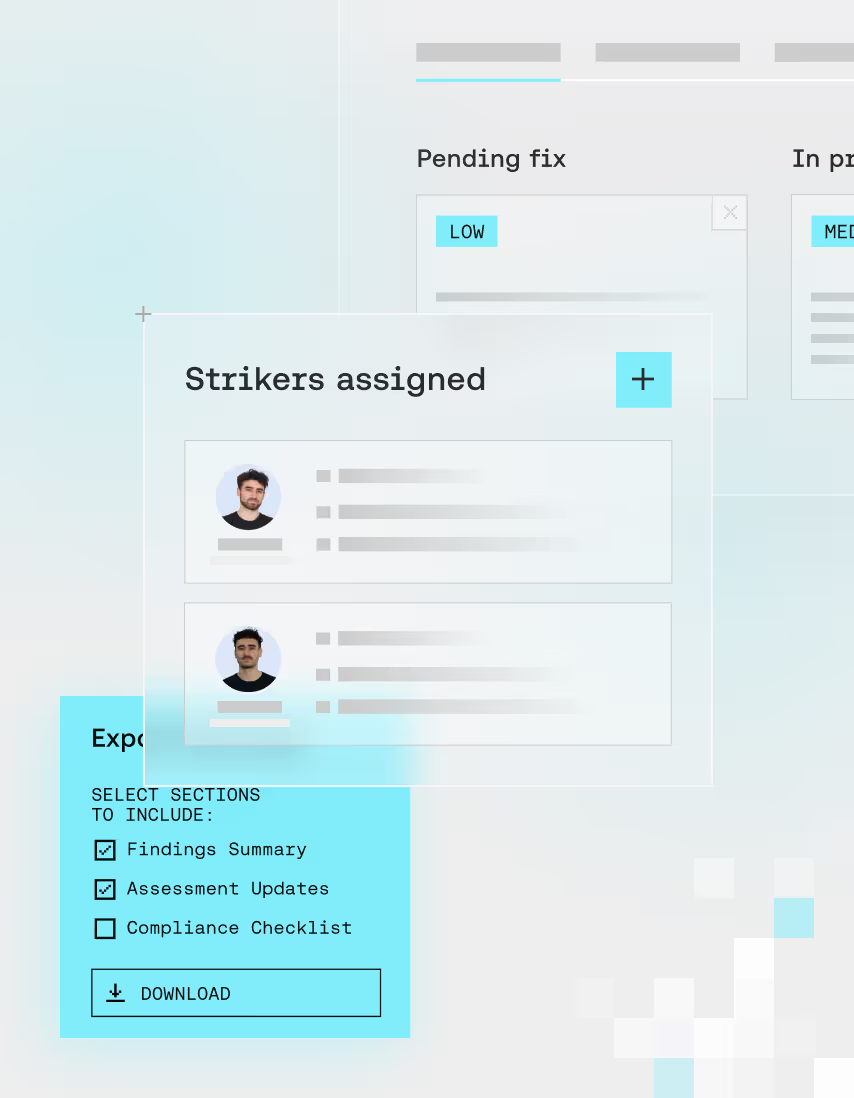
Strikers uncover high-impact vulnerabilities across multi-technology environments (web apps, APIs, mobile, cloud, and more).

AI-led retesting on-demand
Validate fixes without waiting for the next testing cycle. Retesting availability depends on the subscribed scope.

Real-time fixing
AI agents guide your team step-by-step through remediation to accelerate resolution.

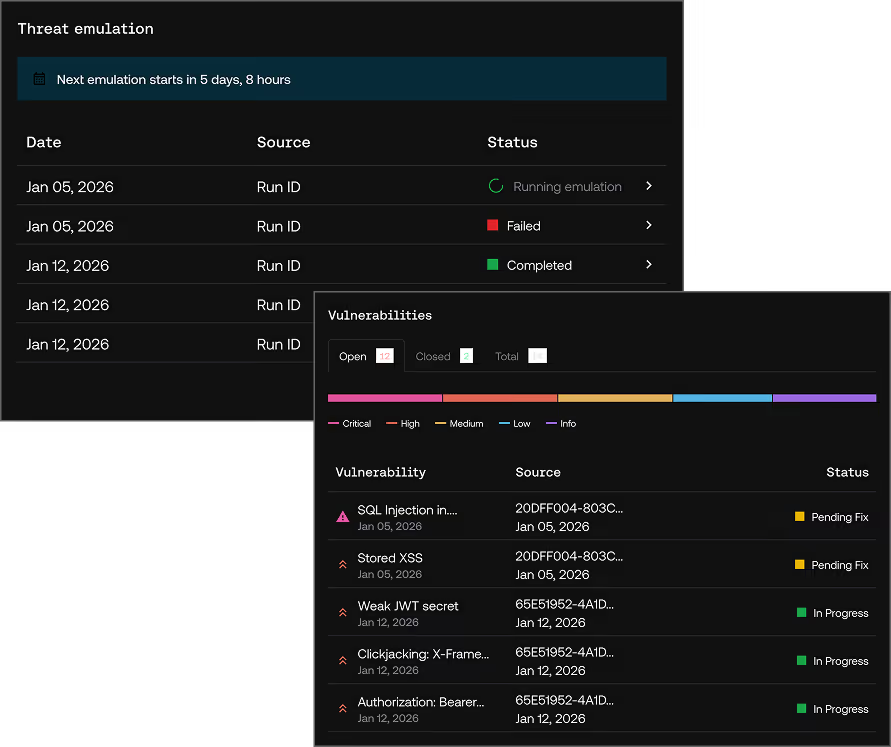
Step-by-step Threat emulation creation
Easily scope, launch, and track your Threat emulation with full transparency.

Human triaging & peer review
Expert human validation before customer delivery, for accuracy and impact.

Full visibility
Track every finding with complete transparency through security expert work logs and real-time notifications.

Seamless integrations
Connect directly with Slack, Teams and Jira to streamline collaboration with your security and development teams.

Vulnerability Manager
Visualize, manage, and retest vulnerabilities in one platform, with full context on severity, sources, and remediation.

Reporting that supports audit and compliance programs
Generate up-to-date reports with evidence per finding to support your PCI DSS, HIPAA, ISO 27001 and SOC 2 programs. Strike does not issue SOC 2 reports, ISO certificates or PCI DSS attestations.

Ongoing partnership
Weekly check-ins with a dedicated Customer Success Manager, plus personalized onboarding and strategic planning.
More than an offensive security platform, Strike operates as a continuous validation layer for environments that never stop changing.

Trusted by security teams that lead






Human expertise.
AI power.
Superior security.
Whether you’re scaling fast, closing enterprise deals, or just tired of noisy reports, we’ll help you build a security stack that moves faster than your threats.
