
What penetration testing actually costs
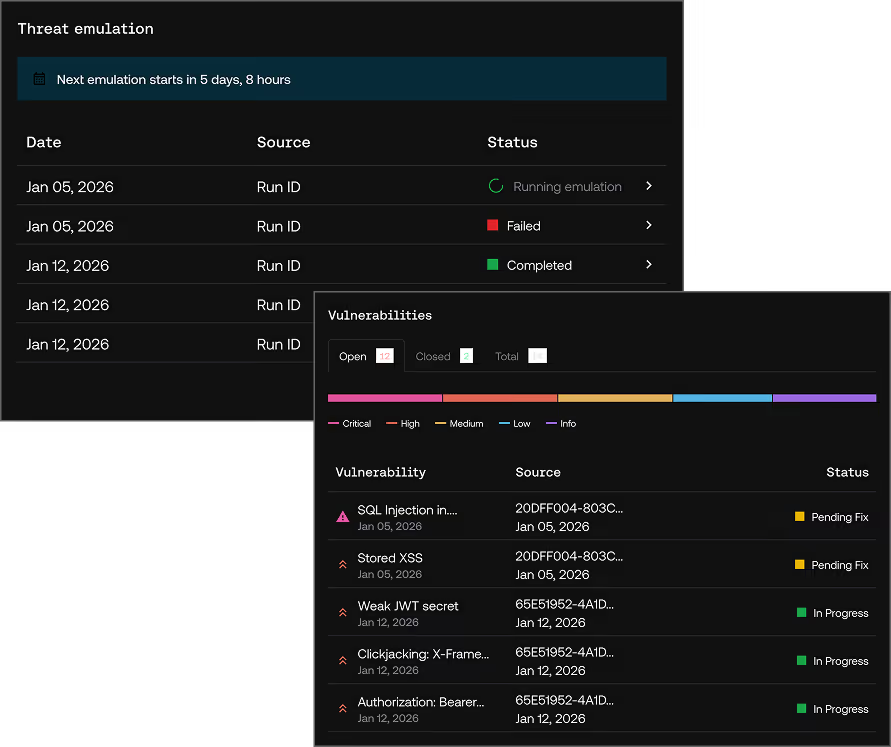
Threat emulation schedule with dates, sources, statuses, and a vulnerabilities list with severity and fix status.

There is no list price for a penetration test, and a provider who quotes one before scoping is selling something other than testing. The price is set by what is in scope, how deep the work goes, who performs it, whether retesting is included, and what evidence has to be produced. This page explains those drivers so that two quotes differing several times over stop being a mystery.

For whoever has to defend the number to finance

Security leaders holding three quotes with a wide spread and no defensible way to explain the difference to a CFO.

Teams budgeting testing for a full year rather than for one engagement, who need retests and change orders in the number from the start.

Buyers who already paid once for an inexpensive engagement that turned out to be an automated scan with a cover page.
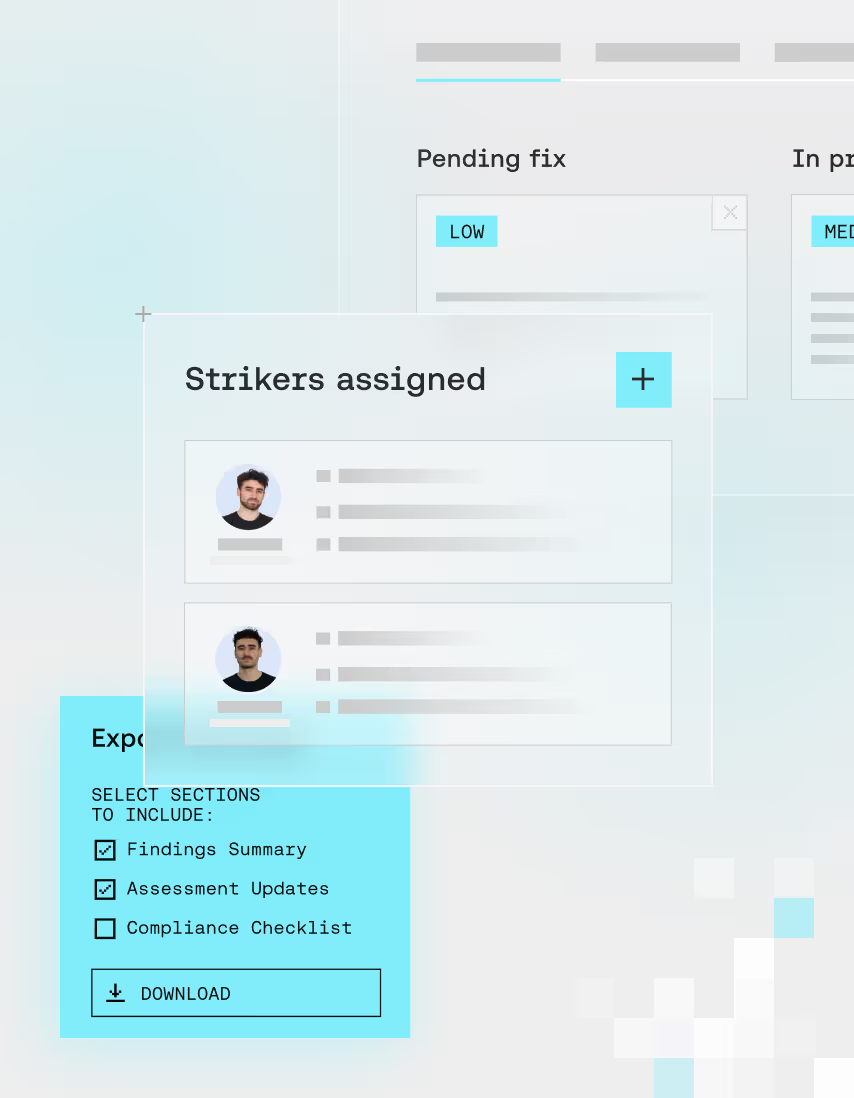
User interface with sections titled 'Strikers assigned' showing two profile pictures and their details, and an 'Export' panel with options to include Findings Summary, Assessment Updates, and Compliance Checklist, with a Download button.
[ PRICING MODELS ]

Three ways to be charged, and what each one does to your budget

Before comparing numbers, compare structures. The same amount of testing costs very differently depending on whether you are buying days of someone's time, a per-asset fee, or a subscription. The structure decides how predictable your year is, what a mid-year change costs you, and whether the retest is a negotiation or a click.

What you should ask about the model
Per engagement or day rate
Per asset
PTaaS subscription
Predictability across a year
Good for one engagement, poor for a year with changes in it
Predictable while the asset count is stable
Predictable by design: one number for the period
Cost of an asset added mid-year
A change order, usually at a worse rate than the original
A new unit on the invoice
Absorbed by the subscription and tested when it appears
Cost of a retest
Often billed separately, sometimes at day rate
Depends on the contract, frequently capped
Included, on demand, with attestation
Coverage between engagements
None. The gap is the model
Whatever the cadence you paid for
Continuous, which is the point of the model
Fit with an audit calendar
Good, if the calendar never moves
Good, and rigid
Evidence available when the auditor asks, not when the window allows
Where the surprise comes from
Scope growth and retests billed after the fact
Asset counting disputes
Renewal scope, which is why the scope definition belongs in the contract

Strike does not publish a price list, and neither should anyone else: a number quoted before scoping is either a placeholder or a different service wearing the same name. What we can do is tell you exactly which variables move it.

What actually moves the price

Scope size, and the type of asset in it
Live hosts, applications, APIs, cloud accounts, mobile builds. Assets are not equivalent units: an application with dozens of roles and a complex authorization model takes far longer than a static marketing site, and a directory with decades of history takes longer than a flat network of the same size.
Depth of testing
Verifying known issues is cheap. Chaining findings, testing multi-role authorization, and reasoning about business logic is not, because it cannot be parallelized or automated away. Most of the price gap between two quotes lives here, and it is the variable buyers ask about least.
Who performs the work
Senior testers cost more per hour and usually cost less per finding, because the expensive part of an engagement is the time spent understanding your system rather than the time spent running tools. Ask who is assigned, not just what the firm's average looks like.
Whether retesting is included
This single line explains a large share of apparently identical quotes. Ask whether retesting is included, how many rounds, over what period, and whether it produces an attestation. If it is excluded, add its likely cost to the quote before you compare.
Evidence and reporting requirements
A report that has to satisfy an auditor takes longer to produce than a findings list. If you need per-finding evidence, an executive summary, tester qualifications and a retest record, say so up front — it is legitimate work and it is cheaper agreed than added later.
Remediation support
Whether your engineers can ask the tester questions while fixing, or whether the engagement ends at delivery. Support shortens time to fix, which is where the value of the whole exercise sits, and it is frequently the difference between a report that gets closed and one that gets filed.

The costs that live outside the quote

The retest you did not price
You will fix things, and someone has to prove the fixes work. If retesting is billed separately, the real cost of the engagement is the quote plus the retest, and that is the number to compare against a provider who included it.
Change orders for assets that appeared later
Scope is agreed at signature and reality moves during the engagement. A subdomain, a new service, an acquisition. In a point-in-time model each of those is a commercial conversation; the cheapest way to avoid the conversation is to agree the handling of new assets in the contract.
Triage hours on a noisy report
A report full of unvalidated findings transfers work to your team. Those hours are real money and they never appear on the invoice, which is why accuracy is a commercial argument and not only a technical one.
The cost of the wait
Weeks between booking and testing, and more weeks between testing and the report, are weeks in which a known-but-unreported issue stays open. Nobody invoices for this and it is often the largest number in the whole exercise.

Comparing two quotes apple to apple

Normalize the scope first
Write down the exact asset list each quote covers, including whether authenticated testing is included and how many user roles. Two quotes covering different scopes are not comparable at any price, and this is the most common reason a decision goes wrong.
Add the excluded items back in
Retests, out-of-hours testing, extra report formats, remediation calls, assets added later. Price each exclusion at whatever the provider says it costs and add it to their number. Cheap quotes usually stop being cheap at this step.
Compare the deliverable, not the label
Ask each provider for a redacted sample report. If one delivers a scanner export and the other delivers exploited paths with evidence, you are looking at two different products that happen to share a name.
Then compare a full year, not one engagement
Add up what twelve months costs under each model: the engagements you plan, the retests, the change orders you can reasonably expect, and the months left uncovered. Point-in-time and continuous stop looking similar as soon as the horizon is a year instead of a quarter.

Frequently asked questions

How much does a penetration test cost?

Honestly: it depends, and any single figure quoted without a scope is not information. What determines the price is the number and type of assets, the depth of the work, the seniority of the testers, whether retesting is included, and how audit-ready the evidence has to be. A useful way to get a real answer quickly is to write your asset list down and ask three providers to quote against that same list.

Why do two quotes for the same scope differ so much?

Usually because they are not the same scope, even when they look like it. One includes authenticated testing across several roles and the other tests unauthenticated. One includes retesting and the other bills it later. One produces an audit-grade report and the other produces a findings list. And in some cases one is manual testing and the other is an automated scan being sold under the same word.

Is a cheap penetration test worth it?

It depends on what you actually bought. If the low price comes from a tighter scope you agreed to, that is a rational trade. If it comes from replacing manual testing with a scan, you have paid for a control you already had, and you will find out during an audit or an incident. The diagnostic question is simple: ask what percentage of the effort is manual, and ask to see a sample report.

Does compliance force you into an expensive test?

It forces you into a defined one. Frameworks care that testing happened, that it covered the right scope, that it was performed by someone qualified, and that findings were remediated and re-verified. Those requirements raise the floor on evidence quality rather than on price. Testing evidence supports SOC 2, ISO/IEC 27001 and PCI DSS programs; nothing you buy certifies compliance on its own.

What does the retest cost?

Somewhere between nothing and a second engagement, depending entirely on the contract. Ask three things before signing: is retesting included, how many rounds and for how long, and does it produce a document you can hand to an auditor. A provider who cannot show you what their retest attestation looks like is probably not including one.

How do I budget penetration testing for a year?

Start from the calendar you cannot move — audits, certification cycles, major releases — and add the testing each one requires. Then add retests, a realistic allowance for assets that will appear during the year, and the internal hours triage will consume. Compare that total against a subscription covering the same estate. The comparison is only fair over twelve months, because that is the horizon where the gaps between engagements start to count.

ALWAYS-ON PLATFORM

More than a test. A strategic layer for real security.

Our AI is powered by a proprietary data layer built from thousands of hours of pentesting and real-world validations. Strike combines autonomous execution and expert human validation to uncover complex risks, reduce noise, and prioritize actionable findings.

In-depth continuous testing

Strikers uncover high-impact vulnerabilities across multi-technology environments (web apps, APIs, mobile, cloud, and more).

AI-led retesting on-demand

Validate fixes instantly, without waiting for the next testing cycle.

Real-time fixing

coming soon

AI agents guide your team step-by-step through remediation to accelerate resolution.

Step-by-step Threat emulation creation

Easily scope, launch, and track your Threat emulation with full transparency.

Human triaging & peer review

Every finding is validated by security experts to ensure accuracy and impact.

Full visibility

Track every finding with complete transparency through security expert work logs and real-time notifications.

Seamless integrations

Connect directly with Slack, Teams and Jira to streamline collaboration with your security and development teams.

Vulnerability Manager

Visualize, manage, and retest vulnerabilities in one platform, with full context on severity, sources, and remediation.

Compliance-ready reporting

Automatically generate up-to-date reports aligned with PCI DSS, HIPAA, ISO 27001, SOC 2, and more.

Ongoing partnership

Weekly check-ins with a dedicated Customer Success Manager, plus personalized onboarding and strategic planning.

More than an offensive security platform, Strike operates as a continuous validation layer for environments that never stop changing.

Boost your experience with Hybrid Testing Booster

Continuous Hybrid Testing

Emulated, deep stealth-based attacks executed by creative, unconventional security experts. Find out how real attackers would breach your systems, and stop them before they do.

Testimonial

Trusted by security teams that lead

"Product was great! The team was exceptional when addressing our sense of urgency with regards to an important timeline, and they were able to deliver effectively and finding important vulnerabilities within our systems."

Gartner 4
Gartner review, Head of Engineering, Banking

"Good option for agile testing, especially if GTM timelines are tight. This is especially important when the release train comes with a lot of new products and releases, making it hard to keep the pace in a traditional ad-hoc business model."

Gartner 3
Gartner review, Product Security Leader Cybersecurity, Hardware

“Strike provides continuous pentesting for our critical web and mobile features. Each month they help us validate new functionalities in production, delivering relevant vulnerabilities and strong value for money. We are very satisfied with their innovative and customer-centric approach.”

Gartner 2
Gartner review, Chief Information Security Officer, Retail

"Strike team was fast and provided the exact solution we needed for our use case. We decided to go for Strike because they provide a pen-testing suite that fits the way we work in terms of speed and communication. Highly recommended!"

Gartner review
Gartner 1
Gartner Review, Chief Technical Officer, Banking

"We greatly value our partnership with Strike. Their exceptional penetration testing services and effective communication have significantly enhanced our cybersecurity, ensuring the safety and trust of our customers' financial information."

Ozan Özgür Özyüksel
Information Security Officer, Plum

"The management of communication channels and the centralization of interactions with the team made the experience much more agile and effective. Having everything in one place was a huge advantage and allowed us to complete the pentest within just a few weeks."

Miguel Langone
CTO at Horizon

“Working with Strike is extremely important to us, especially because they deliver quality work over our products in a continuous way, and provide constant follow-up when it comes to managing the already found vulnerabilities. Moreover, they are constantly making improvements in their SaaS platform so we can have the best experience possible. In case we have a problem, they listen and help us. That’s invaluable.”

Ileana Barrionuevo
Sr AppSec Red Team, NaranjaX

“Working with Strike was an excellent experience for us. We were able to create our own pentests and change their scope each month. The Strikers are world-class professionals who provide us with relevant findings quickly and efficiently. Also, automated tools like Phishing Monitor are really interesting for our company, because they help us spot fake domains trying to impersonate PedidosYa.”

Eduardo Gimenez
CISO, Pedidos Ya

“For us at pier, security is the most important aspect, not only on the surface but throughout our entire product. When we reached out to Strike, we were looking for someone that could test & find vulnerabilities across our entire stack. We are very happy that we have found the right partner to achieve that, and we are looking forward to continuing this important work together.”

Andras Hejj
CEO & CTO, Pier

Human expertise.
AI power.
Superior security.

Whether you’re scaling fast, closing enterprise deals, or just tired of noisy reports, we’ll help you build a security stack that moves faster than your threats.

Book a Demo