
How to choose a penetration testing company
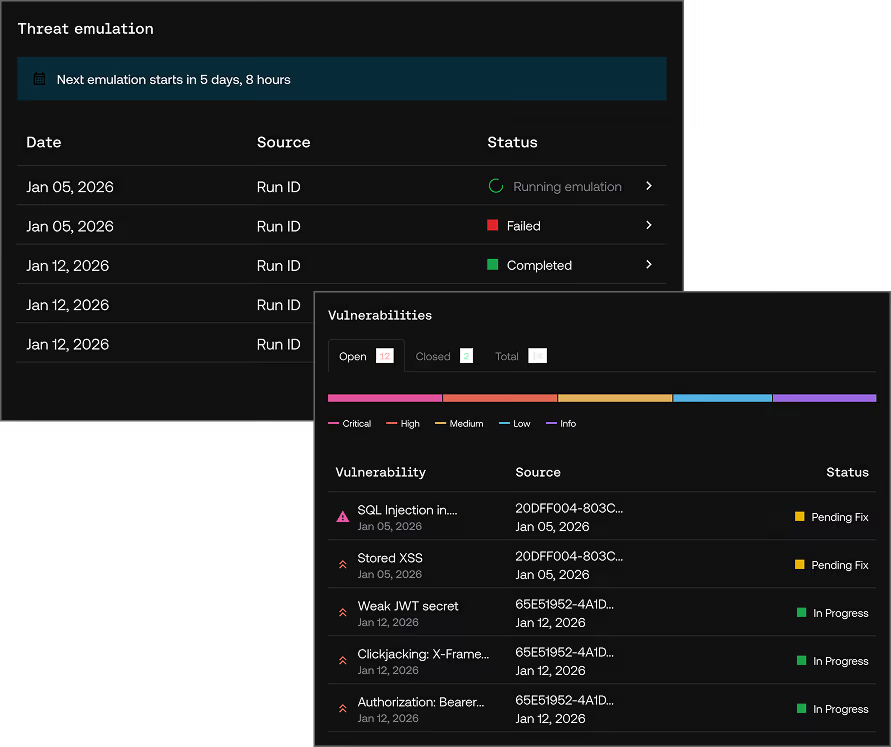
Threat emulation schedule with dates, sources, statuses, and a vulnerabilities list with severity and fix status.

A penetration testing company is a provider whose testers manually attack your systems to prove which flaws are actually exploitable. Compare providers on eight things: who the testers are and how you verify it, the methodology they declare, whether retesting is included, time to first finding, evidence quality for auditors, point-in-time versus continuous coverage, SDLC integration, and what the price leaves out.


Who is this for?

Security leaders running an RFP who need a defensible way to separate providers that all promise the same outcome.

Teams whose last report turned out to be a scanner export with a cover page, and who now need evidence an auditor will accept.

Engineering organizations shipping every week, for whom a single annual engagement leaves eleven months untested.
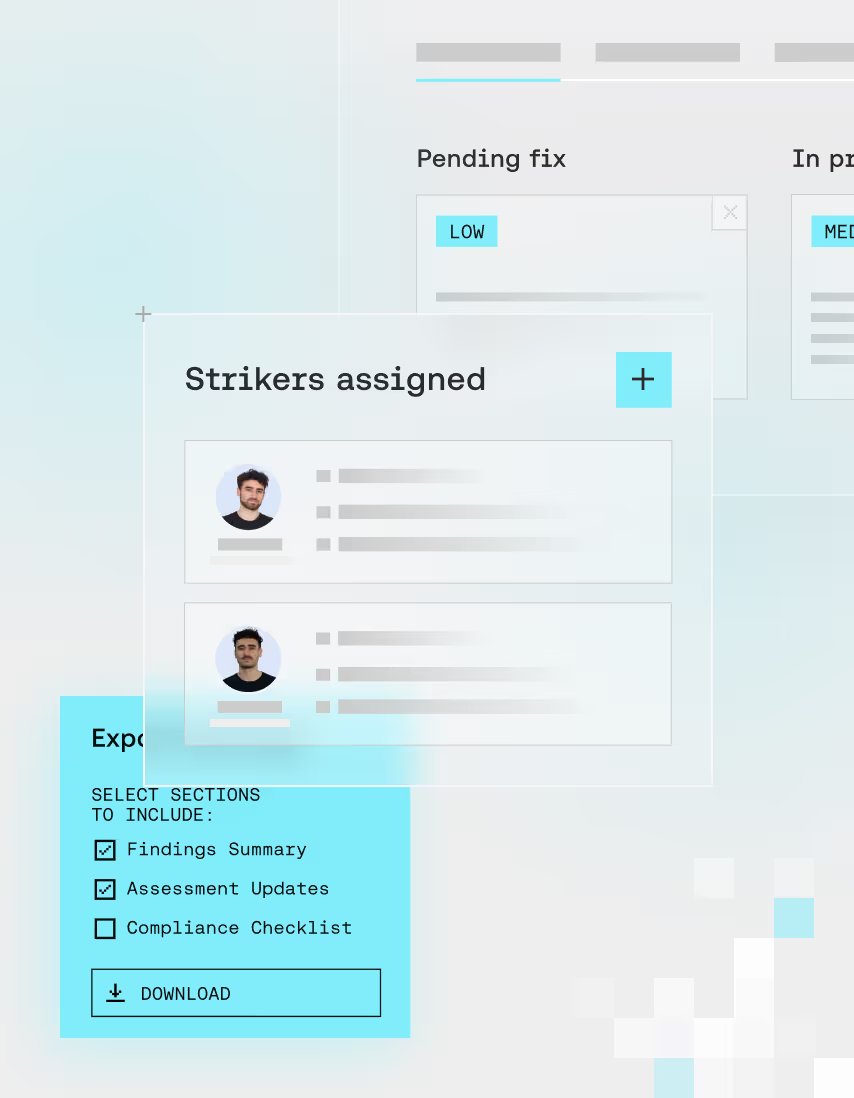
User interface with sections titled 'Strikers assigned' showing two profile pictures and their details, and an 'Export' panel with options to include Findings Summary, Assessment Updates, and Compliance Checklist, with a Download button.
[ PROVIDER EVALUATION ]

Four ways to buy a penetration test, compared

Most penetration testing companies fall into one of four delivery models, and the model matters more than the logo. Before comparing vendors, compare the models: they differ in who actually tests, how often, how much triage lands on your team, and whether the output survives an audit.

What you are comparing
Traditional consultancy
Marketplace / crowdsourced
Automated scanner platform
Continuous PTaaS (Strike)
Who actually tests
A team assigned by the firm, usually not named until kickoff
A rotating pool of freelance researchers
No one. A scanning engine runs signatures
Named, vetted pentesters backed by autonomous testing
Cadence of coverage
One engagement per year, sometimes two
Per campaign or bounty window
Always on, but shallow
Always on, and retested on every change
Noise you inherit
Low: findings are filtered by hand
Varies by researcher and by submission
High: triage lands on your team
97% accuracy, under 3% false positives
Retesting
Usually a separate line item
Often outside the scope of the payout
A rescan, not a validation
Included, on demand, with attestation
Evidence for auditors
Formal report, delivered at the end
Depends entirely on the platform
Scanner output, rarely accepted on its own
Audit-ready report plus retest attestation
Business-logic and authorization flaws
Found, inside the scoped window
Sometimes, driven by payout incentives
Not found: a scanner has no notion of intent
Found by humans, continuously

Named vendor comparisons live on their own pages. This grid is about the delivery model, which is the decision you make first.

The eight-criteria evaluation framework

1. Tester credentials, and how you verify them
Ask for the certifications the assigned testers hold (OSCP, GPEN, CREST CRT are the common baselines) and for public research, CVEs or write-ups with their names on them. A provider that will not tell you who tests your systems is selling you a process, not expertise.
2. The methodology and standards they declare
Ask which methodology governs the work and how it maps to your assets: the OWASP Top 10 for web, the OWASP API Security Top 10 for APIs, and a documented internal process for infrastructure. Then ask to see how one finding was evidenced end to end.
3. Whether retesting is included or billed separately
A finding is not closed until the fix is proven. Ask whether retesting is included, how many rounds, and for how long. This one line item is the most common difference between two proposals that otherwise look identical.
4. Time to first finding, and time to report
These are two different clocks and you should ask for both. A provider that quotes only a report date is telling you nothing about when your engineers can start fixing things.
5. Evidence quality, and whether an auditor will accept it
Ask for a redacted sample report. Every finding should carry reproduction steps, business impact, affected assets and remediation guidance, plus an executive summary a non-technical reader can follow. Testing evidence supports SOC 2 and ISO/IEC 27001 programs; no report certifies compliance on its own.
6. Point-in-time coverage versus continuous coverage
An annual engagement describes the systems you had on the day it ran. If you deploy weekly, ask the provider directly how the other eleven months are covered, and what happens when a new subdomain or service appears mid-year.
7. Integration with your SDLC and ticketing
Findings that live only in a PDF get fixed slowly. Ask about API access, Jira or ticketing integration, and whether a developer can see, question and resolve a finding without waiting for a scheduled readout.
8. The pricing model, and what falls outside it
Ask what the quote excludes: retests, assets added mid-engagement, out-of-hours testing, remediation support, extra report formats. Scope changes are where an inexpensive proposal quietly becomes an expensive one.

Frequently asked questions

How much do penetration testing companies charge?

There is no single market rate, because the price tracks the scope rather than the service name. The variables that move it most are the number and type of assets in scope, the depth of testing, the seniority of the testers, whether retesting is included, and whether the provider has to produce audit-grade evidence. Two quotes for the same application can differ several times over purely because one includes retesting and manual business-logic testing and the other does not.

What certifications should the testers hold?

The widely recognized hands-on credentials are OSCP from OffSec, GPEN from GIAC, and the CREST registered and certified tester tracks. CEH is common but is knowledge-based rather than practical. Certifications are a floor, not a ceiling: ask additionally for published research, CVEs or bug bounty history attached to the specific people who will test your systems.

How long does a penetration test take end to end?

For a traditional engagement, plan for scoping and scheduling before testing even starts, then a testing window, then report writing and a readout, and finally a retest once fixes ship. The calendar time is usually dominated by the queue and the report, not by the testing itself. Continuous models change the shape of this: testing starts once and findings arrive as they are validated, so the clock that matters becomes time to first validated finding.

Do I need a penetration testing company, or are scanning tools enough?

Scanners are good at finding known, signature-matched issues at scale and you should run them. They cannot find flaws that depend on understanding intent: broken authorization between two user roles, a business rule that can be skipped, a chain of three low findings that together reach your data. Those require a human attacker, and they are also the findings that turn into real incidents.

How do I verify that a report will hold up in an audit?

Ask for a redacted sample before you sign. An auditor generally wants to see the scope tested, the dates, the methodology, the identity or qualification of the testers, each finding with severity and evidence, and proof that issues were remediated and retested. A scanner export with a cover page usually fails that bar. Pentest evidence supports SOC 2 and ISO/IEC 27001 programs; it does not certify them.

What should I ask in a penetration testing RFP?

Ask who tests and what they are certified in; which methodology is followed; what the deliverables are and whether a sample is available; whether retesting is included and how many rounds; time to first finding and time to report; how new assets discovered mid-engagement are handled; how findings reach engineers; and an explicit list of what is out of scope. Ask every shortlisted provider the same set, in writing, so the answers are comparable.

ALWAYS-ON PLATFORM

More than a test. A strategic layer for real security.

Our AI is powered by a proprietary data layer built from thousands of hours of pentesting and real-world validations. Strike combines autonomous execution and expert human validation to uncover complex risks, reduce noise, and prioritize actionable findings.

In-depth continuous testing

Strikers uncover high-impact vulnerabilities across multi-technology environments (web apps, APIs, mobile, cloud, and more).

AI-led retesting on-demand

Validate fixes instantly, without waiting for the next testing cycle.

Real-time fixing

coming soon

AI agents guide your team step-by-step through remediation to accelerate resolution.

Step-by-step Threat emulation creation

Easily scope, launch, and track your Threat emulation with full transparency.

Human triaging & peer review

Every finding is validated by security experts to ensure accuracy and impact.

Full visibility

Track every finding with complete transparency through security expert work logs and real-time notifications.

Seamless integrations

Connect directly with Slack, Teams and Jira to streamline collaboration with your security and development teams.

Vulnerability Manager

Visualize, manage, and retest vulnerabilities in one platform, with full context on severity, sources, and remediation.

Compliance-ready reporting

Automatically generate up-to-date reports aligned with PCI DSS, HIPAA, ISO 27001, SOC 2, and more.

Ongoing partnership

Weekly check-ins with a dedicated Customer Success Manager, plus personalized onboarding and strategic planning.

More than an offensive security platform, Strike operates as a continuous validation layer for environments that never stop changing.

Boost your experience with Hybrid Testing Booster

Continuous Hybrid Testing

Emulated, deep stealth-based attacks executed by creative, unconventional security experts. Find out how real attackers would breach your systems, and stop them before they do.

Testimonial

Trusted by security teams that lead

"Product was great! The team was exceptional when addressing our sense of urgency with regards to an important timeline, and they were able to deliver effectively and finding important vulnerabilities within our systems."

Gartner 4
Gartner review, Head of Engineering, Banking

"Good option for agile testing, especially if GTM timelines are tight. This is especially important when the release train comes with a lot of new products and releases, making it hard to keep the pace in a traditional ad-hoc business model."

Gartner 3
Gartner review, Product Security Leader Cybersecurity, Hardware

“Strike provides continuous pentesting for our critical web and mobile features. Each month they help us validate new functionalities in production, delivering relevant vulnerabilities and strong value for money. We are very satisfied with their innovative and customer-centric approach.”

Gartner 2
Gartner review, Chief Information Security Officer, Retail

"Strike team was fast and provided the exact solution we needed for our use case. We decided to go for Strike because they provide a pen-testing suite that fits the way we work in terms of speed and communication. Highly recommended!"

Gartner review
Gartner 1
Gartner Review, Chief Technical Officer, Banking

"We greatly value our partnership with Strike. Their exceptional penetration testing services and effective communication have significantly enhanced our cybersecurity, ensuring the safety and trust of our customers' financial information."

Ozan Özgür Özyüksel
Information Security Officer, Plum

"The management of communication channels and the centralization of interactions with the team made the experience much more agile and effective. Having everything in one place was a huge advantage and allowed us to complete the pentest within just a few weeks."

Miguel Langone
CTO at Horizon

“Working with Strike is extremely important to us, especially because they deliver quality work over our products in a continuous way, and provide constant follow-up when it comes to managing the already found vulnerabilities. Moreover, they are constantly making improvements in their SaaS platform so we can have the best experience possible. In case we have a problem, they listen and help us. That’s invaluable.”

Ileana Barrionuevo
Sr AppSec Red Team, NaranjaX

“Working with Strike was an excellent experience for us. We were able to create our own pentests and change their scope each month. The Strikers are world-class professionals who provide us with relevant findings quickly and efficiently. Also, automated tools like Phishing Monitor are really interesting for our company, because they help us spot fake domains trying to impersonate PedidosYa.”

Eduardo Gimenez
CISO, Pedidos Ya

“For us at pier, security is the most important aspect, not only on the surface but throughout our entire product. When we reached out to Strike, we were looking for someone that could test & find vulnerabilities across our entire stack. We are very happy that we have found the right partner to achieve that, and we are looking forward to continuing this important work together.”

Andras Hejj
CEO & CTO, Pier

Human expertise.
AI power.
Superior security.

Whether you’re scaling fast, closing enterprise deals, or just tired of noisy reports, we’ll help you build a security stack that moves faster than your threats.

Book a Demo