Network penetration testing

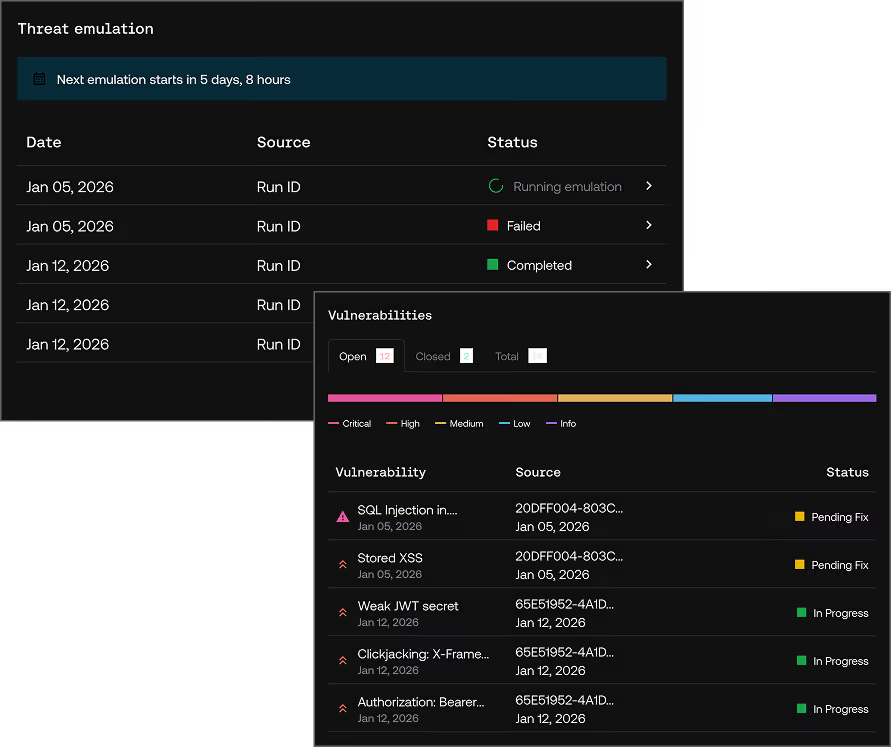
Threat emulation schedule with dates, sources, statuses, and a vulnerabilities list with severity and fix status.

A network penetration test attacks the infrastructure layer: the perimeter, remote access, network devices, exposed services, the segmentation between zones, and the directory that authenticates all of it. A good tester does not hand back a list of missing patches. They chain what they find into a path — exposed service, foothold, domain control — and show you exactly where that path can be broken.

For the teams who own the infrastructure, not just the app

Infrastructure and IT teams who inherited a network built over a decade and need to know which of its old assumptions still hold.

Organizations with flat or partially segmented networks that want to know how far one compromised laptop actually gets.

Teams running an Active Directory estate that nobody has deliberately attacked since the day it was set up.
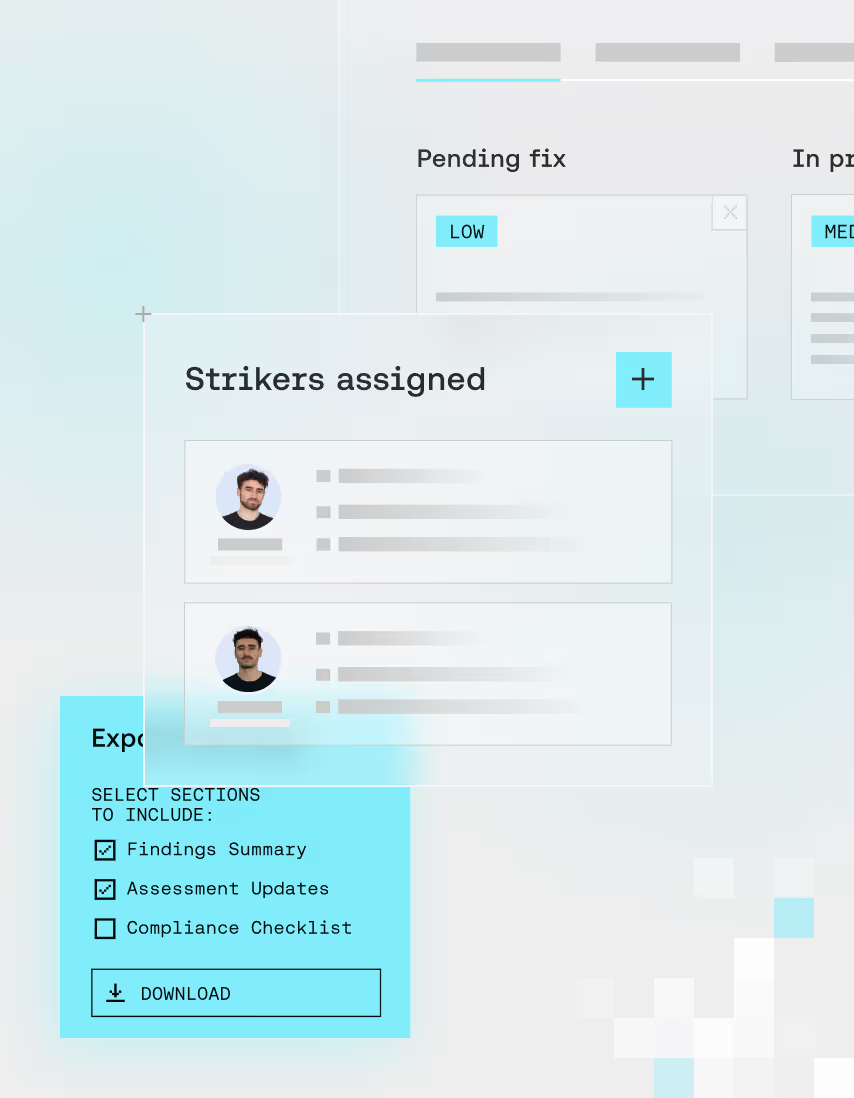
User interface with sections titled 'Strikers assigned' showing two profile pictures and their details, and an 'Export' panel with options to include Findings Summary, Assessment Updates, and Compliance Checklist, with a Download button.
[ INFRASTRUCTURE LAYER ]

What a network test covers that a scan and an app test do not

The three get quoted against each other as if they were interchangeable. They answer different questions. A scan tells you what is known to be wrong right now. An application test tells you whether one product can be abused by the people allowed to use it. A network test tells you how far someone gets once they are inside your infrastructure — and it is the only one of the three that produces an attack path.

The question behind the purchase
Vulnerability scan
Web application pentest
Network penetration test
What it targets
Whatever it can reach, matched against known signatures
One application: its logic, its authorization model, its data handling
Hosts, services, network devices, remote access and the directory that authenticates them
The question it answers
Which known issues exist on these systems today?
Can this application be abused by someone allowed to use it?
How far can an attacker move once they are inside the network?
Chaining of findings
None. Every finding is reported on its own
Central, but bounded by the application
Central. Three medium findings can add up to domain-level control
Segmentation and lateral movement
Not evaluated at all
Out of scope
Explicitly tested, and usually where the real finding is
Credentials used
Usually unauthenticated, or a single service account
Accounts at two or more privilege levels, provided up front
Often none to start with, then whatever the tester captures along the way
What you get back
A ranked list of known issues to triage yourself
Findings per endpoint and per role, with reproduction steps
Attack paths, each with the single step that breaks it

The scan column is not a competitor. It is a control you should also be running — the point is that it answers a different question. Strike runs the network test continuously rather than in a yearly window, so a newly exposed service gets tested when it appears.

The five phases, and what each one produces

1. Reconnaissance
Mapping what exists: address ranges, hostnames, exposed services, remote access endpoints, and anything reachable that nobody meant to expose. The output of this phase is very often the first surprise — an inventory that does not match the one you were given.
2. Enumeration
Turning the map into detail: service versions, share permissions, authentication mechanisms, directory objects, trust relationships, and where default or weak configurations survive. Nothing is exploited yet, but this is where the plan is written.
3. Exploitation
Turning one of those details into a foothold, and proving it. The bar is a working, evidenced entry point, not a theoretical one. Findings that cannot be demonstrated get reported as observations, not as compromise.
4. Lateral movement
Moving from that foothold toward something that matters, and testing whether segmentation stops it. This is the phase that turns a mid-severity technical finding into a business statement: this host reaches that database.
5. Privilege escalation
Climbing from an ordinary account toward administrative or directory-level control, then documenting the full chain and the earliest point at which a single change would have broken it. That last part is what makes the report actionable.

Findings that come back most often, and why they matter

Unpatched or end-of-life services
Usually not the crown jewels: a forgotten management interface, an old appliance, a test box that stayed up. It matters because it is a foothold, and a foothold is the only thing an attacker needs to start the rest of the chain.
Weak SMB and SNMP configuration
Shares readable by everyone, message signing not enforced, community strings left at defaults. These rarely look severe on their own and are frequently the mechanism by which credentials or topology leak to a tester who already has a foothold.
Exposed remote access
RDP, SSH or a management portal reachable without multi-factor authentication, or a VPN concentrator running old firmware. Remote access is the most attractive target on any perimeter because success there requires no exploit at all — just a valid password.
Permissive firewall and ACL rules
Rules added for a migration that finished three years ago, any-to-any entries, and zones that are only nominally separate. The finding is not the rule, it is what the rule allows once someone is standing on the wrong side of it.
Flat networks and failed segmentation
A user workstation VLAN that can reach a database, a payment zone that a printer network can talk to, backup infrastructure sitting alongside production. Segmentation is the control that limits blast radius, and it is very often assumed rather than verified.
Directory misconfiguration
Over-privileged service accounts, credentials cached where they should not be, delegation set up years ago and never reviewed. The directory is what turns a single compromised machine into control over everything that trusts it, which is why it deserves its own attention in scope.

Frequently asked questions

What does a network penetration test include?

Discovery of what is actually reachable, enumeration of the services and directory objects behind it, exploitation of at least one path to a foothold, lateral movement to test segmentation, and privilege escalation toward administrative or directory-level control. The deliverable should describe the chain, not just the individual weaknesses, and should name the earliest step where one change breaks the whole path.

Should I run an internal or an external network test?

They answer different questions and mature programs run both. External testing asks what a stranger on the internet can reach and exploit. Internal testing starts from the assumption that someone is already inside — a phished user, a contractor laptop, a compromised device — and measures how far that gets. If you have never run either, start external, because that is where opportunistic attacks arrive.

How long does a network penetration test take?

In a traditional engagement the testing window is usually the smallest part of the calendar time; scheduling, report writing and the retest cycle take longer. Duration scales with the number of live hosts and the complexity of the directory, not with the size of the address range. In a continuous model there is no window: testing runs, and findings are delivered as each one is validated.

Do testers need credentials for a network test?

Not to start. A useful internal test usually begins unauthenticated to reproduce the position of an attacker who just landed on the network, then uses whatever it captures. Providing a standard user account as well is worth doing, because it lets the tester cover the authenticated attack surface in the time available instead of spending the engagement earning access you could have granted.

Can a network penetration test break something?

Any active testing carries some risk, which is why scope, timing and escalation contacts are agreed in advance. Denial-of-service testing is normally excluded by default. Fragile legacy systems should be flagged so they can be handled carefully or tested in a mirrored environment. The realistic risk is a service becoming briefly unresponsive, and it should be covered by an agreed contact who can act immediately.

How is this different from running a vulnerability scanner?

A scanner reports what is known to be wrong with each system in isolation. A network test reports what an attacker can do with those systems together. The difference shows up in the findings that matter most: a permissive firewall rule, an over-privileged service account and one unpatched host are three unremarkable entries on a scan report and one domain compromise on a pentest report.

[ THE TWO HALVES OF THE SCOPE ]

A network engagement is usually bought as two halves. Each has its own page, because each answers a different question.

Our solution architecture

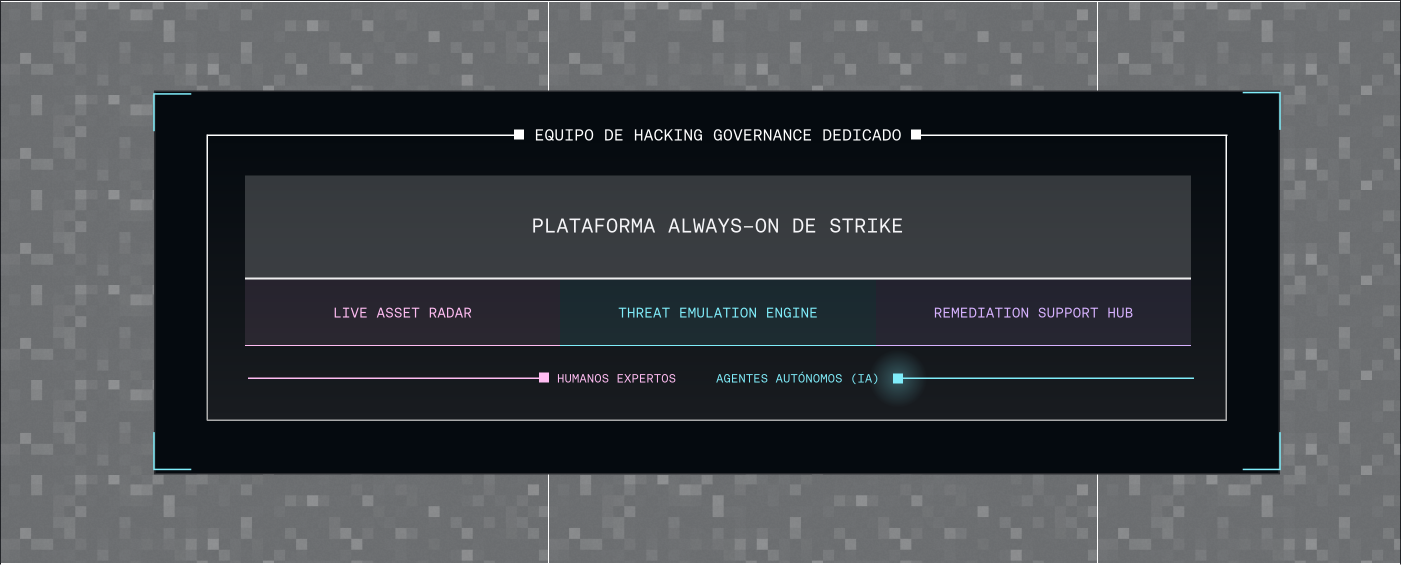
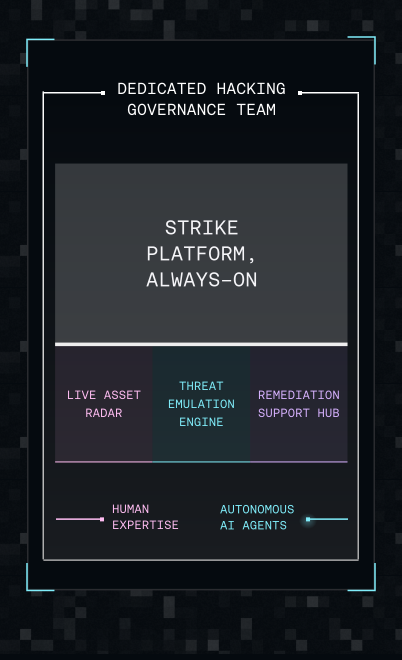
A centralized platform that combines continuous asset monitoring, autonomous threat emulation, and expert remediation support—powered by AI agents, human validation, and a dedicated governance team.
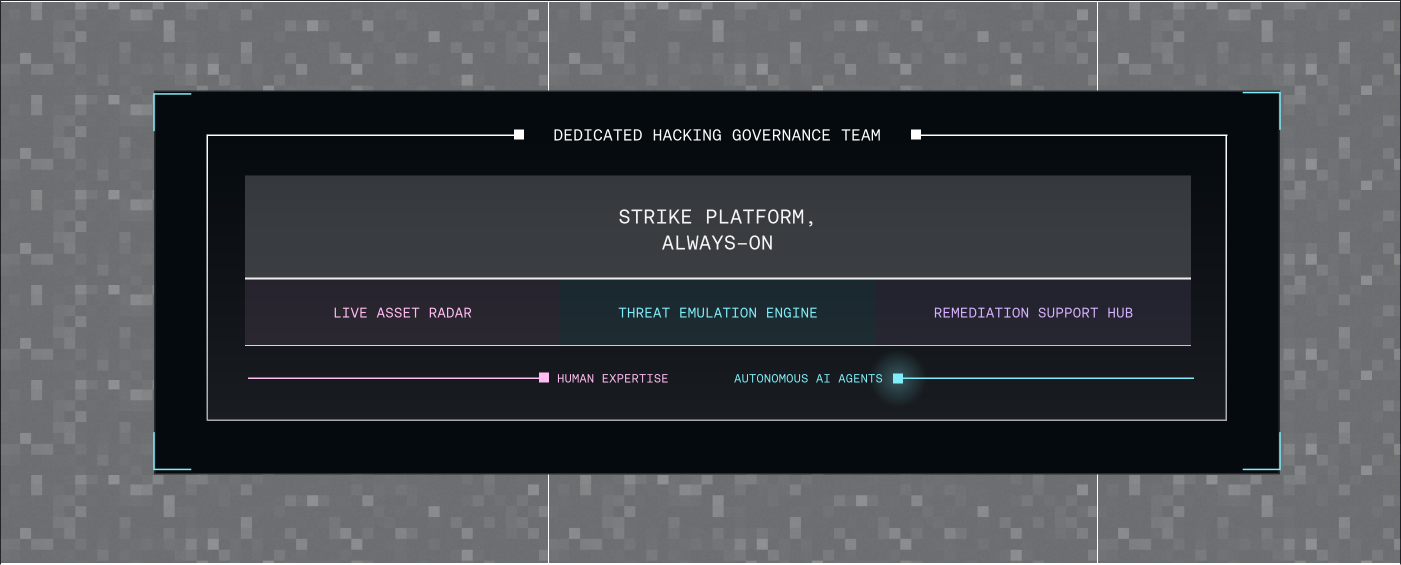
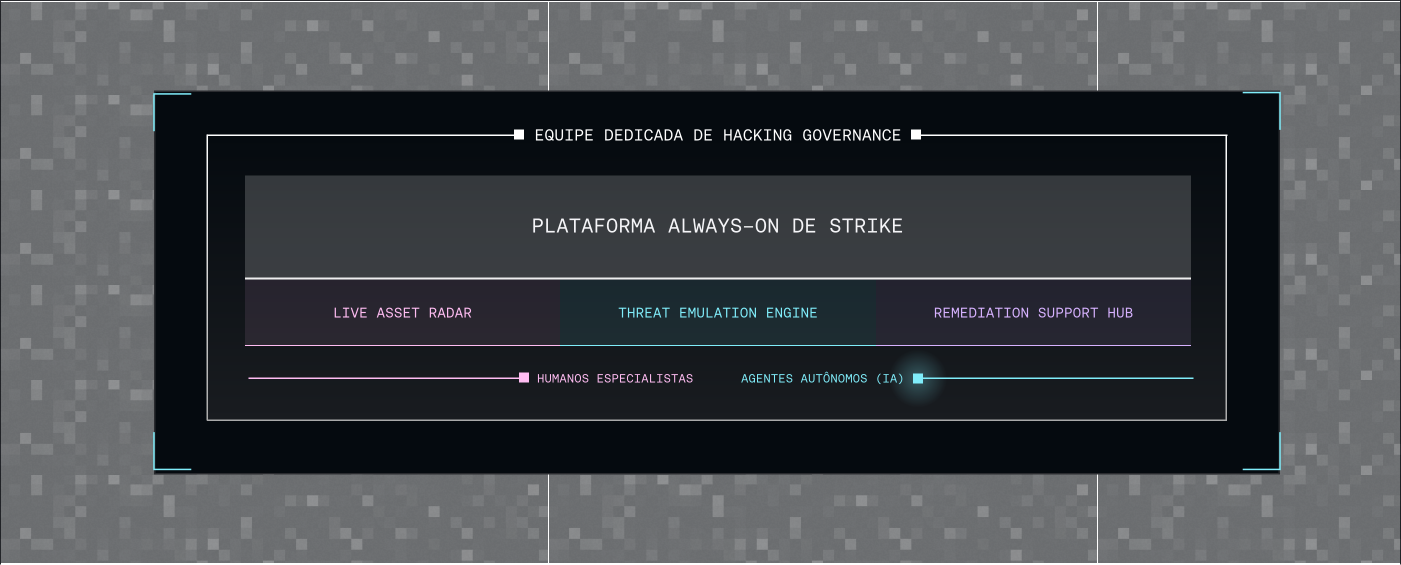
ALWAYS-ON PLATFORM

More than a test. A strategic layer for real security.

Our AI is powered by a proprietary data layer built from thousands of hours of pentesting and real-world validations. Strike combines autonomous execution and expert human validation to uncover complex risks, reduce noise, and prioritize actionable findings.

In-depth continuous testing

Strikers uncover high-impact vulnerabilities across multi-technology environments (web apps, APIs, mobile, cloud, and more).

AI-led retesting on-demand

Validate fixes instantly, without waiting for the next testing cycle.

Real-time fixing

coming soon

AI agents guide your team step-by-step through remediation to accelerate resolution.

Step-by-step Threat emulation creation

Easily scope, launch, and track your Threat emulation with full transparency.

Human triaging & peer review

Every finding is validated by security experts to ensure accuracy and impact.

Full visibility

Track every finding with complete transparency through security expert work logs and real-time notifications.

Seamless integrations

Connect directly with Slack, Teams and Jira to streamline collaboration with your security and development teams.

Vulnerability Manager

Visualize, manage, and retest vulnerabilities in one platform, with full context on severity, sources, and remediation.

Compliance-ready reporting

Automatically generate up-to-date reports aligned with PCI DSS, HIPAA, ISO 27001, SOC 2, and more.

Ongoing partnership

Weekly check-ins with a dedicated Customer Success Manager, plus personalized onboarding and strategic planning.

More than an offensive security platform, Strike operates as a continuous validation layer for environments that never stop changing.

Boost your experience with Hybrid Testing Booster

Continuous Hybrid Testing

Emulated, deep stealth-based attacks executed by creative, unconventional security experts. Find out how real attackers would breach your systems, and stop them before they do.

Testimonial

Trusted by security teams that lead

"Product was great! The team was exceptional when addressing our sense of urgency with regards to an important timeline, and they were able to deliver effectively and finding important vulnerabilities within our systems."

Gartner 4
Gartner review, Head of Engineering, Banking

"Good option for agile testing, especially if GTM timelines are tight. This is especially important when the release train comes with a lot of new products and releases, making it hard to keep the pace in a traditional ad-hoc business model."

Gartner 3
Gartner review, Product Security Leader Cybersecurity, Hardware

“Strike provides continuous pentesting for our critical web and mobile features. Each month they help us validate new functionalities in production, delivering relevant vulnerabilities and strong value for money. We are very satisfied with their innovative and customer-centric approach.”

Gartner 2
Gartner review, Chief Information Security Officer, Retail

"Strike team was fast and provided the exact solution we needed for our use case. We decided to go for Strike because they provide a pen-testing suite that fits the way we work in terms of speed and communication. Highly recommended!"

Gartner review
Gartner 1
Gartner Review, Chief Technical Officer, Banking

"We greatly value our partnership with Strike. Their exceptional penetration testing services and effective communication have significantly enhanced our cybersecurity, ensuring the safety and trust of our customers' financial information."

Ozan Özgür Özyüksel
Information Security Officer, Plum

"The management of communication channels and the centralization of interactions with the team made the experience much more agile and effective. Having everything in one place was a huge advantage and allowed us to complete the pentest within just a few weeks."

Miguel Langone
CTO at Horizon

“Working with Strike is extremely important to us, especially because they deliver quality work over our products in a continuous way, and provide constant follow-up when it comes to managing the already found vulnerabilities. Moreover, they are constantly making improvements in their SaaS platform so we can have the best experience possible. In case we have a problem, they listen and help us. That’s invaluable.”

Ileana Barrionuevo
Sr AppSec Red Team, NaranjaX

“Working with Strike was an excellent experience for us. We were able to create our own pentests and change their scope each month. The Strikers are world-class professionals who provide us with relevant findings quickly and efficiently. Also, automated tools like Phishing Monitor are really interesting for our company, because they help us spot fake domains trying to impersonate PedidosYa.”

Eduardo Gimenez
CISO, Pedidos Ya

“For us at pier, security is the most important aspect, not only on the surface but throughout our entire product. When we reached out to Strike, we were looking for someone that could test & find vulnerabilities across our entire stack. We are very happy that we have found the right partner to achieve that, and we are looking forward to continuing this important work together.”

Andras Hejj
CEO & CTO, Pier

Human expertise.
AI power.
Superior security.

Whether you’re scaling fast, closing enterprise deals, or just tired of noisy reports, we’ll help you build a security stack that moves faster than your threats.

Book a Demo