
Cybersecurity companies in Chile: how to compare them
Searching for cybersecurity companies in Chile returns a results page that mixes several different business models under one label: compliance-certification platforms, offensive-security consultancies that only run penetration tests, broad IT integrators where security is one line in a catalogue that also sells switches and Oracle training, and at least one case where the URL ranking for cybersecurity now redirects to a software-development page. None of them is better than the others in the abstract. They answer different problems. What follows are the criteria that separate them, and four providers a Chilean buyer runs into when comparing — two operating locally, two regional or international — each with its source and access date.

Who is this for?
Security leaders choosing a provider in Chile with a board or an auditor waiting for evidence, under the framework Ley 21.663 created.
Teams that have to justify a provider choice to a risk committee or an external auditor, and need the reasoning written down.
Organisations deciding whether one provider covers Chile properly, or whether the problem needs more than one.
Four providers, anchored in different parts of the problem
These four providers are not substitutes for one another, which is what a price-led comparison tends to hide. Each is anchored somewhere different: compliance certification, specialised offensive security per project, PTaaS on a credit-based model, and continuous offensive validation. Every row states what each company publishes in its own materials, consulted on 29 July 2026. The order is not a quality ranking.
Strike publishes this page and is one of the providers listed. Every row describes what each company states in its own public materials, consulted on 29 July 2026. No performance figure for any other provider is reproduced here.
Sources, all consulted on 29 July 2026. Ley 21.663: BCN, Ley Chile. CMF, Chapter 20-10 of the RAN: cmfchile.cl. Strike: Strike methodology.
ISO/IEC 27001:2022, “Information security, cybersecurity and privacy protection — Information security management systems — Requirements”, edition 3, published October 2022. Certification is issued by an accredited certification body, not by a testing provider. Consulted 29 July 2026: iso.org/standard/27001
PCI DSS, PCI Security Standards Council. The Council states that whether an entity is required to comply with or validate compliance to a PCI SSC standard “is at the discretion of organizations that manage compliance programs, such as a payment brand, acquirer, or other entity”. Consulted 29 July 2026: pcisecuritystandards.org
The criteria that matter in a regulated environment
Frequently asked questions
Which is the best cybersecurity company in Chile?
There is no single answer, and any page that gives you one is selling something. It depends on the authorised scope, the regulatory framework that applies to you, and whether the need is a point-in-time test or recurring validation. The criteria above are designed so you can build your own comparison and reach a different conclusion from ours.
Can a cybersecurity company certify your compliance?
No. Certifications are issued by accredited bodies and by auditors outside the commercial relationship. An offensive security provider supplies technical evidence that supports audit and compliance programs, and that is where its contribution ends. Treat any provider that offers to certify or guarantee compliance with caution.
What is the difference between a pentest and continuous validation?
A traditional penetration test is a point-in-time exercise with a start date and an end date, and it describes the systems you had while it ran. Continuous validation runs recurring tests against authorised assets instead. In Strike's model, testing can be triggered by changes according to the configured scope.
Which Chilean regulations frame this decision?
Two are worth knowing. Ley 21.663, the Cybersecurity Framework Law, was enacted on 26 March 2024 and published on 8 April 2024, and created the National Cybersecurity Agency (ANCI). For supervised financial entities, the CMF's Chapter 20-10 of the Recopilacion Actualizada de Normas sets out the management of information security and cybersecurity, and applies to banks, banking subsidiaries, support societies and card issuers and operators. Whether a penetration test specifically is expected of your entity is determined by your own supervisor or assessor, not by a provider: it was not found stated in the public materials reviewed on 29 July 2026. Sources are linked at the foot of this page.
How do I compare two proposals fairly?
Turn the criteria above into the same written questions for every shortlisted provider, and require evidence rather than assurances: how exploitability is demonstrated, what triggers a test, who validates a finding before delivery, what evidence is produced for auditors, what coverage depends on, and how the setup, execution and delivery timelines differ from one another.
What does offensive security cost in Chile?
The price tracks the scope rather than the service name: the number and type of assets, the depth of testing, whether retesting is available under the subscribed scope, and whether the provider has to produce evidence an auditor will accept. Two quotes for the same application can differ several times over for those reasons alone.
ALWAYS-ON PLATFORM
More than a test. A strategic layer for real security.
Our AI is powered by a proprietary data layer built from thousands of hours of pentesting and real-world validations. Strike combines autonomous execution and expert human validation to uncover complex risks, reduce noise, and prioritize actionable findings.

In-depth continuous testing
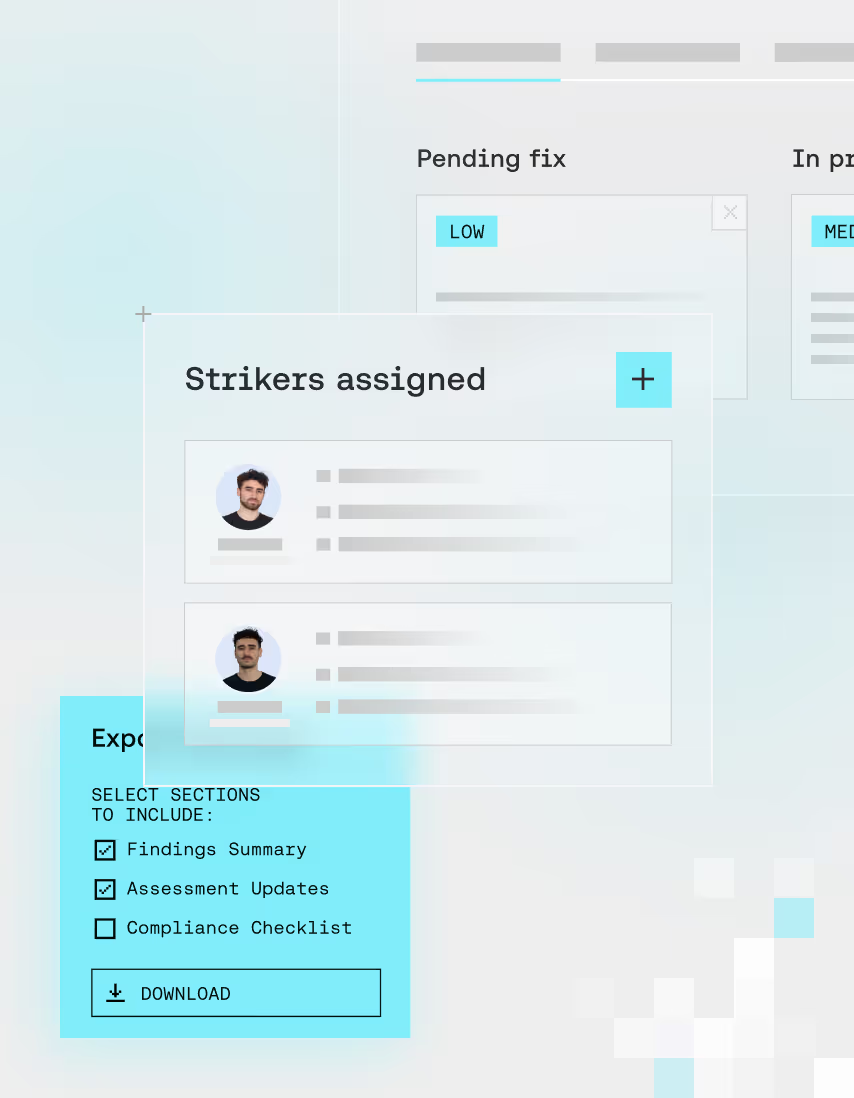
Strikers uncover high-impact vulnerabilities across multi-technology environments (web apps, APIs, mobile, cloud, and more).

AI-led retesting on-demand
Validate fixes without waiting for the next testing cycle. Retesting availability depends on the subscribed scope.

Real-time fixing
AI agents guide your team step-by-step through remediation to accelerate resolution.

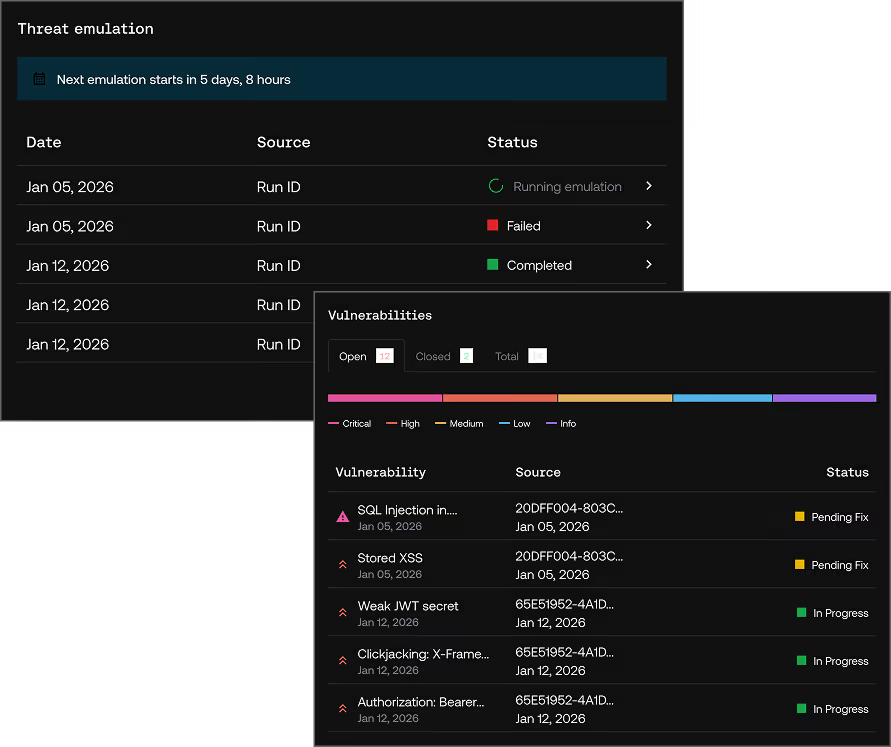
Step-by-step Threat emulation creation
Easily scope, launch, and track your Threat emulation with full transparency.

Human triaging & peer review
Expert human validation before customer delivery, for accuracy and impact.

Full visibility
Track every finding with complete transparency through security expert work logs and real-time notifications.

Seamless integrations
Connect directly with Slack, Teams and Jira to streamline collaboration with your security and development teams.

Vulnerability Manager
Visualize, manage, and retest vulnerabilities in one platform, with full context on severity, sources, and remediation.

Reporting that supports audit and compliance programs
Generate up-to-date reports with evidence per finding to support your PCI DSS, HIPAA, ISO 27001 and SOC 2 programs. Strike does not issue SOC 2 reports, ISO certificates or PCI DSS attestations.

Ongoing partnership
Weekly check-ins with a dedicated Customer Success Manager, plus personalized onboarding and strategic planning.
More than an offensive security platform, Strike operates as a continuous validation layer for environments that never stop changing.

Trusted by security teams that lead






Human expertise.
AI power.
Superior security.
Whether you’re scaling fast, closing enterprise deals, or just tired of noisy reports, we’ll help you build a security stack that moves faster than your threats.
