
Cybersecurity companies in Brazil: how to compare and choose
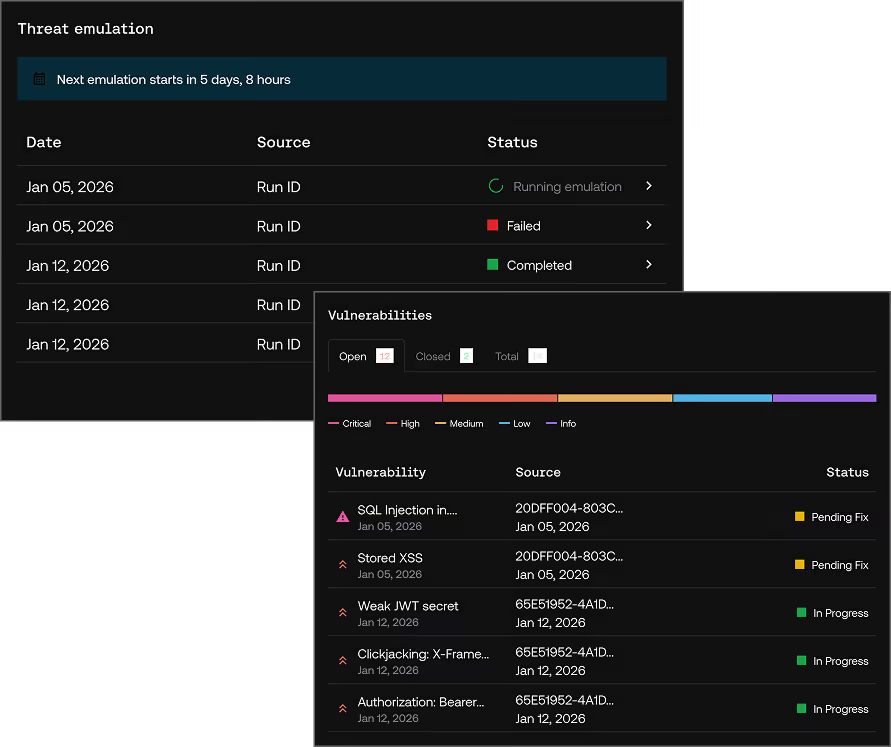
Threat emulation schedule with dates, sources, statuses, and a vulnerabilities list with severity and fix status.

Choosing a cybersecurity company in Brazil is hard for a reason that rarely gets said out loud: the word covers markets that barely overlap. A firewall vendor, a compliance consultancy and an offensive security specialist solve different problems, with different teams and different contracts. Comparing all three on the same list leads to the wrong decision. This guide organises the market by vendor category, sets out which criteria carry weight in a Brazilian regulated environment, and says plainly where each category — ours included — does not operate.

Who this page is for

Security leaders holding proposals from vendors in different categories, who need to compare them without falling into the trap of treating them as equivalent.

Teams in a regulated environment that need to show an auditor that security validation happened and that the evidence holds up.

Engineering organisations that deploy every week, for whom a single annual test leaves eleven months without current validation.
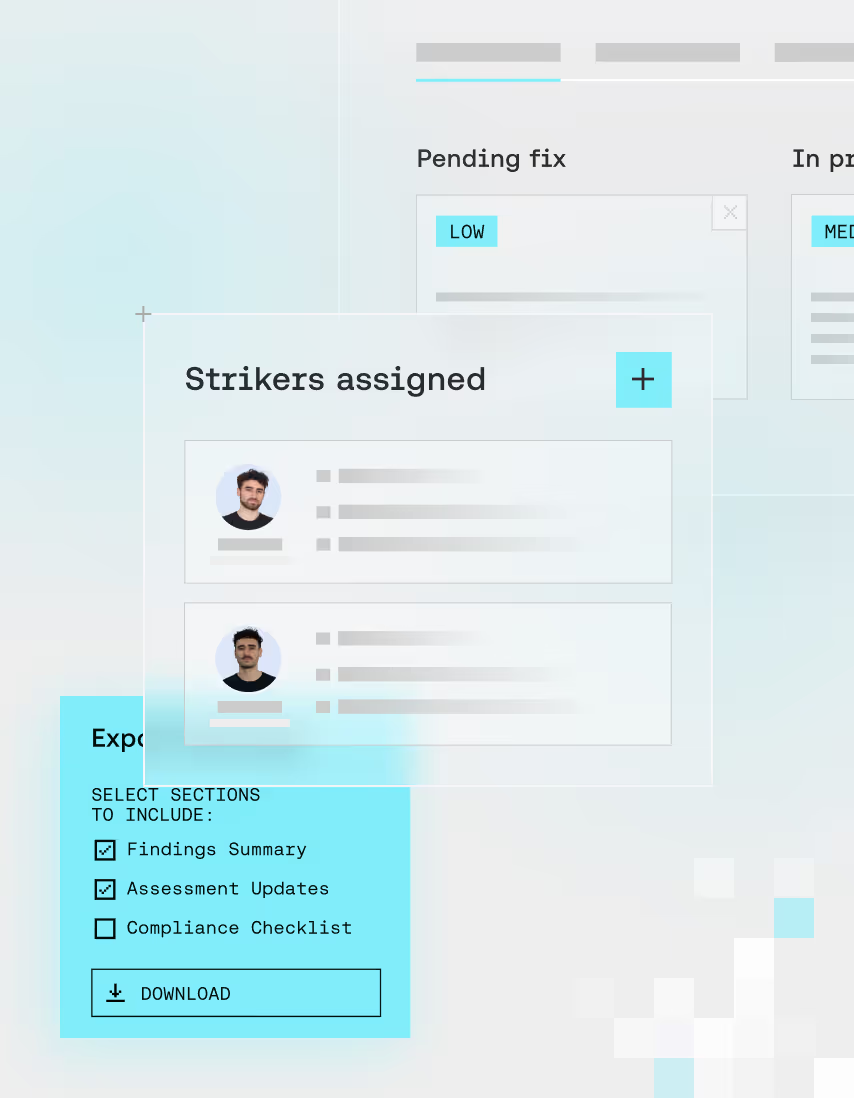
User interface with sections titled 'Strikers assigned' showing two profile pictures and their details, and an 'Export' panel with options to include Findings Summary, Assessment Updates, and Compliance Checklist, with a Download button.
[ VENDOR CATEGORIES ]

Four categories of cybersecurity vendor, compared

In Brazil, “cybersecurity company” describes businesses that barely compete with one another. Before comparing brands, compare categories, because the category decides what you get: who operates, how often, how much triage is left for your team, and whether the result serves your audit programme.

What you are comparing
Defence and infrastructure
Compliance consulting
Managed services (MSSP)
Offensive security (Strike)
What it solves
Real-time blocking and detection: firewall, WAF, EDR, SIEM
Assessment, policy and audit preparation
Outsourced monitoring operations, 24/7
Finding and validating what is genuinely exploitable, from the attacker's perspective
Cadence of coverage
Continuous, but limited to what the tool recognises
Point-in-time, tied to a project or an audit cycle
Continuous in monitoring, not in offensive validation
Continuous; tests can be triggered by changes, according to the configured scope
Noise you inherit
High: alerts at volume, prioritisation left to your team
Low, but the deliverable is a document, not technical proof
Medium: depends on the contract and the level of triage
97% precision / under 3% false positives (Strike-reported)
Retesting
Not applicable: the control is permanent, not a test
New project, new budget
Not applicable
Retesting availability depends on the subscribed scope
Evidence for auditors
Logs and configurations: useful, but not a test
Reports and policies, in the format auditors expect
Logs and alerts: rarely accepted as evidence of testing
Supports audit and compliance programmes, with evidence per finding
Business-logic and authorisation flaws
Out of reach: the control does not assess business intent
Appear as a policy gap, not as a proven flaw
Not found: monitoring has no notion of intent
Found with expert human validation, continuously

This grid compares vendor categories, which is the decision that comes first. Comparisons with named vendors live on their own pages.

The criteria that carry weight in a regulated environment

1. Which regulatory scope do you operate in?
For financial institutions, Resolução CMN 4.893/2021, as amended in December 2025, frames cybersecurity policy requirements — including penetration testing (“testes de intrusão”) at a minimum annual frequency. For personal data processing, art. 46 of the LGPD provides for technical and administrative security measures without naming any specific test (primary sources: normativos.bcb.gov.br and planalto.gov.br, accessed 2026-07-29). A vendor should demonstrate that it supports your programme; no vendor certifies compliance on your behalf.
2. Validated finding, or merely reported finding?
Reported vulnerability volume is the easiest metric to inflate and the least useful. Every false positive consumes engineering time, and that cost does not appear in the proposal. Ask what share of findings is confirmed exploitable before delivery, and how that was measured. At Strike there is expert human validation before customer delivery, at 97% precision / under 3% false positives (Strike-reported — see Our methodology).
3. Continuous or point-in-time?
An annual assessment describes the system as it stood on the day it was assessed. If your surface changes every week, the vendor's cadence has to keep up. Ask how many times a year the asset is assessed and what triggers a new execution.
4. What exactly is the authorised scope?
Coverage depends on the authorised scope and the access granted. No vendor reaches what it cannot access. Ask which credentials, environments and network ranges the work depends on, and what is left out if they are not provided.
5. Is there real presence in the region?
Time zone, language, a contract in Portuguese and an understanding of the Brazilian regulatory framework stop being details the moment a regulatory examination starts. Ask who handles your account, in which time zone, and in which language the report is delivered.
6. Does the evidence serve your audit programme?
Penetration test reports are requested in PCI DSS, SOC 2 and ISO/IEC 27001:2022 processes. A report that supports those programmes needs reproduction steps and evidence per finding, not just a severity list. Strike supports audit and compliance programmes from its offensive testing, and does not issue SOC 2 reports, ISO certificates or PCI DSS attestations. Primary sources, consulted on 2026-07-28: PCI SSC, PCI Data Security Standard, AICPA, SOC 2 - Trust Services Criteria and ISO/IEC 27001:2022.
Two categories that sit outside this grid
Incident response contains and investigates after an incident, and makes sense under an agreement signed in advance, before you need it. Architecture consulting designs controls, but does not prove they hold. Neither replaces offensive validation, and offensive validation replaces neither of them.
What Strike does not do
We are not defence, SIEM, WAF, security awareness, bug bounty or compliance automation. We are offensive security specialists. If your need is one of those, a vendor specialised in it will serve you better than we will.
[ PENETRATION TESTING COMPANIES IN BRAZIL ]

Penetration testing companies in Brazil: who does what

Lists of the best penetration testing companies in Brazil are almost always published by someone who appears in them — including this one. So what follows is not a ranking. It is the category map, the companies that operate in each, and an explicit note on where Strike does not compete.

1. Continuous offensive validation (PTaaS)
Tests what is already in production, continuously, and delivers validated findings rather than a queue of alerts. This is the category that answers a minimum-annual intrusion-testing requirement when the programme needs more than one window a year. Companies operating here: Strike, Blaze Information Security, Conviso.
2. Project-based penetration testing
Fixed scope, defined window, report at the end. It is the format most Brazilian institutions already know, and it maps directly onto a minimum annual frequency. Companies operating here: Vantico, Clavis, novuln.
3. Bug bounty and vulnerability disclosure
Pays per vulnerability found, through a researcher community. It complements a scoped test rather than replacing it, because coverage depends on who chose to look. Companies operating here: BugHunt.
4. Managed SOC and incident response
Monitors, detects and responds. It answers a different question from a penetration test: not what can be exploited, but what is happening right now. Companies operating here: Tempest.
5. GRC consulting and application security
GRC consulting structures policy, controls and the relationship with the regulator; it organises the programme the test sits inside. Application security acts before deploy — code review, SAST, DAST, dependencies — reducing what reaches production without observing production itself.

Company websites, reviewed on 2026-07-29, are the source for each category description. No third-party performance figures are published on this page: any comparison of results between vendors would require data published by that vendor, and that was not found in the public materials reviewed on 2026-07-29.

Frequently asked questions

What is the difference between a cybersecurity company and an information security consultancy?

A consultancy usually delivers assessment, policy and audit preparation: the product is a document. An offensive security company delivers technical proof: what is exploitable now and with what impact. The two are bought at different moments in the programme, and one does not cover the other.

Does a cybersecurity company certify my LGPD compliance?

No. Certificates and attestations are issued by certification bodies and independent auditors. A security vendor supports the programme by supplying evidence; it does not certify it. Treat with suspicion any proposal that promises compliance as a deliverable.

Do I need a Brazilian vendor?

Not necessarily. But a contract in Portuguese, a compatible time zone and familiarity with the BCB framework and the LGPD materially reduce friction in a regulatory examination, and that friction tends to appear at the worst possible moment.

How long does it take to get started?

Three separate clocks, which should not be added together. At Strike, platform setup takes under 5 minutes for supported scopes; the start of execution depends on sizing and authorisation; and the curated set of findings arrives in 1-2 hours of execution, with the first validated finding in about 1 hour.

Should one vendor cover every category?

Rarely at the same depth. A vendor claiming to cover defence, compliance, monitoring and offensive security at the same level deserves harder questions, not fewer. Ask which one is the speciality and who executes the others.

How do we compare two proposals fairly?

Send the same written questionnaire to every shortlisted vendor, using the six criteria above, and ask for a redacted sample report before signing. Answers given in different formats are not comparable, and that is exactly where a price difference stops being explainable.

Human expertise.
AI power.
Superior security.

Whether you’re scaling fast, closing enterprise deals, or just tired of noisy reports, we’ll help you build a security stack that moves faster than your threats.


Book a Demo

Boost your experience with Hybrid Testing Booster

Continuous Hybrid Testing

Emulated, deep stealth-based attacks executed by creative, unconventional security experts. Find out how real attackers would breach your systems, and stop them before they do.

Testimonial

Trusted by security teams that lead

"Product was great! The team was exceptional when addressing our sense of urgency with regards to an important timeline, and they were able to deliver effectively and finding important vulnerabilities within our systems."

Head of Engineering
Banking · Gartner Peer Insights review

"Good option for agile testing, especially if GTM timelines are tight. This is especially important when the release train comes with a lot of new products and releases, making it hard to keep the pace in a traditional ad-hoc business model."

Product Security Leader, Cybersecurity
Hardware · Gartner Peer Insights review

“Strike provides continuous pentesting for our critical web and mobile features. Each month they help us validate new functionalities in production, delivering relevant vulnerabilities and strong value for money. We are very satisfied with their innovative and customer-centric approach.”

Chief Information Security Officer
Retail · Gartner Peer Insights review

"Strike team was fast and provided the exact solution we needed for our use case. We decided to go for Strike because they provide a pen-testing suite that fits the way we work in terms of speed and communication. Highly recommended!"

Gartner review
Chief Technical Officer
Banking · Gartner Peer Insights review

"We greatly value our partnership with Strike. Their exceptional penetration testing services and effective communication have significantly enhanced our cybersecurity, ensuring the safety and trust of our customers' financial information."

Information Security Officer
Strike customer

"The management of communication channels and the centralization of interactions with the team made the experience much more agile and effective. Having everything in one place was a huge advantage and allowed us to complete the pentest within just a few weeks."

CTO
Horizon

“Working with Strike is extremely important to us, especially because they deliver quality work over our products in a continuous way, and provide constant follow-up when it comes to managing the already found vulnerabilities. Moreover, they are constantly making improvements in their SaaS platform so we can have the best experience possible. In case we have a problem, they listen and help us. That’s invaluable.”

Sr AppSec Red Team
NaranjaX

“Working with Strike was an excellent experience for us. We were able to create our own pentests and change their scope each month. The Strikers are world-class professionals who provide us with relevant findings quickly and efficiently. Also, automated tools like Phishing Monitor are really interesting for our company, because they help us spot fake domains trying to impersonate our brand.”

CISO
Strike customer

“For us, security is the most important aspect, not only on the surface but throughout our entire product. When we reached out to Strike, we were looking for someone that could test & find vulnerabilities across our entire stack. We are very happy that we have found the right partner to achieve that, and we are looking forward to continuing this important work together.”

CEO & CTO
Strike customer