
Build vs Buy AI Pentesting: Should You Build It or Buy It?
For most security teams, buying wins. Getting a frontier model is the easy part; the durable advantage is three things you can't assemble on a weekend — proprietary offensive data, expert human validation, and continuous, governed operation.


Who this comparison is for
Security leaders weighing whether to stand up an in-house AI pentesting capability or buy one off the shelf.
Engineering leaders asked to “just wire an LLM to our scanner”, who want to know what that really takes to trust.
Buyers comparing a build estimate against a platform subscription, trying to see the true total cost of each.
What building actually costs, and what it doesn't
Building an in-house AI pentesting tool and buying a platform are not the same thing at two prices. Wiring an LLM to a scanner is a weekend; making its findings trustworthy is not. And finding vulnerabilities is only the start — retesting, vulnerability intelligence, remediation, attack-surface mapping and reporting that supports your audits are just as much of the offensive-security job. The model is the commodity; the durable advantage is the proprietary data behind it, the expert humans who train and validate it, and the safe, continuous operation around it. Underestimating all of that is where most in-house AI pentesting projects stall.
Keeping pace as models and attacks change
Constant re-work as technologies, models and attack vectors evolve every week
Best models and task-specialized agents, orchestrated and kept current for you
Strike combines AI-led execution with expert human validation, continuously.
Why buying usually wins
Why building is harder than it looks
Frequently asked questions
Is it cheaper to build AI pentesting in-house?
No. It's only cheaper if you count the model cost. Once you add the proprietary data, human validation, safe continuous operation and enterprise governance that make results trustworthy, the total cost of an in-house tool usually exceeds a platform — and takes far longer to reach.
Isn't the company with the best model at an advantage?
For a continuous programme the argument fades: base models converge to a commodity, and any short-lived exclusive doesn't change the fundamentals. The moat is proprietary data, human craft and continuous operation — not the model.
Does buying help with compliance audits?
Strike supports audit and compliance programmes with reports aligned to PCI DSS, SOC 2 and ISO 27001, and operates under ISO 27001, SOC 2 Type II, HIPAA and GDPR. Strike supports your programme; it does not issue certifications. Source: PCI DSS v4.0.1, PCI SSC Document Library (consulted 28 July 2026). Source: ISO/IEC 27001:2022 (consulted 28 July 2026).
What does an in-house build actually require?
Access to a model is the easy part. A trustworthy tool also needs a proprietary offensive-data layer, a validation step that removes false positives, safe continuous execution with guardrails and isolation, and enterprise governance — each a project of its own to build and maintain.
When does building or open-source make sense?
If you only need a one-off test, if price is the single deciding factor, building or using open source can be the right call. For a continuous, high-quality, governed programme, buying a hybrid platform is faster and safer.
What does Strike give you that a self-built tool doesn't?
Strike combines AI-led execution with expert human validation, continuously: proprietary offensive data, a detection agent paired with a validation agent, expert review before delivery, safe isolated execution, and reports that support your audit and compliance programmes — without you building or maintaining any of it.
ALWAYS-ON PLATFORM
More than a test. A strategic layer for real security.
Our AI is powered by a proprietary data layer built from thousands of hours of pentesting and real-world validations. Strike combines autonomous execution and expert human validation to uncover complex risks, reduce noise, and prioritize actionable findings.

In-depth continuous testing
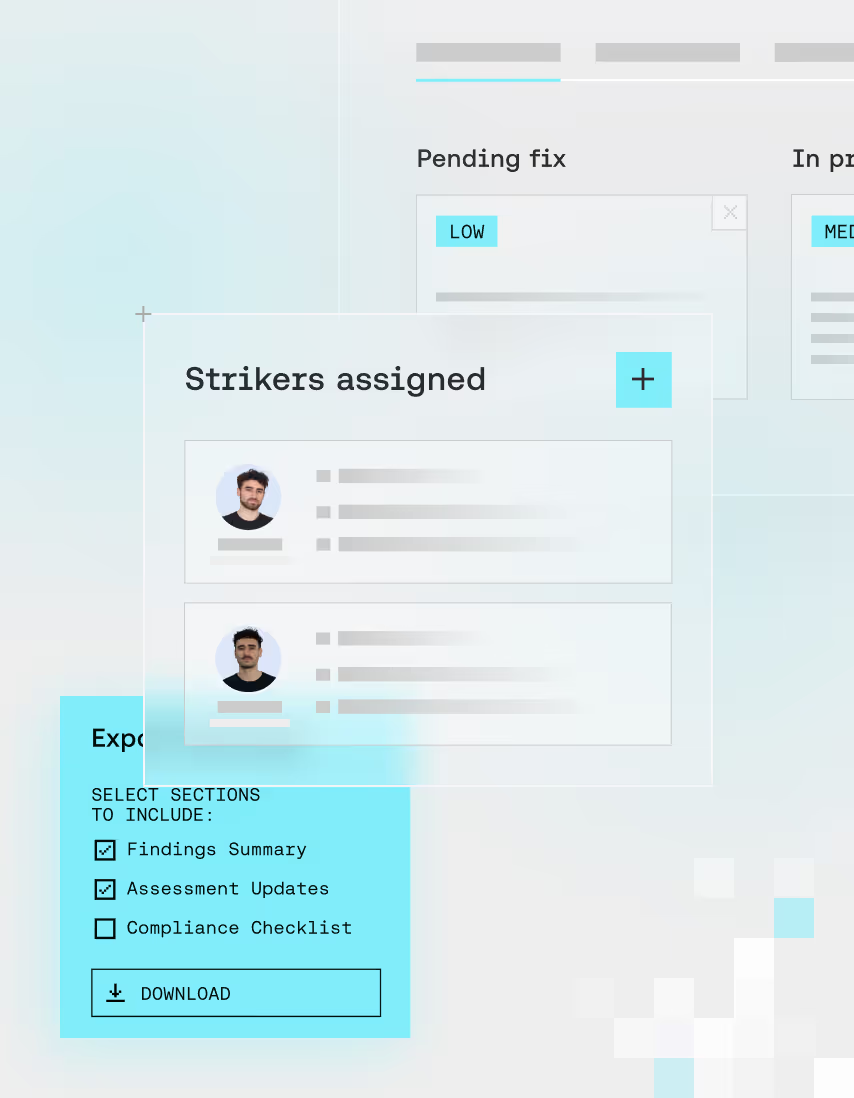
Strikers uncover high-impact vulnerabilities across multi-technology environments (web apps, APIs, mobile, cloud, and more).

AI-led retesting on-demand
Validate fixes without waiting for the next testing cycle. Retesting availability depends on the subscribed scope.

Real-time fixing
AI agents guide your team step-by-step through remediation to accelerate resolution.

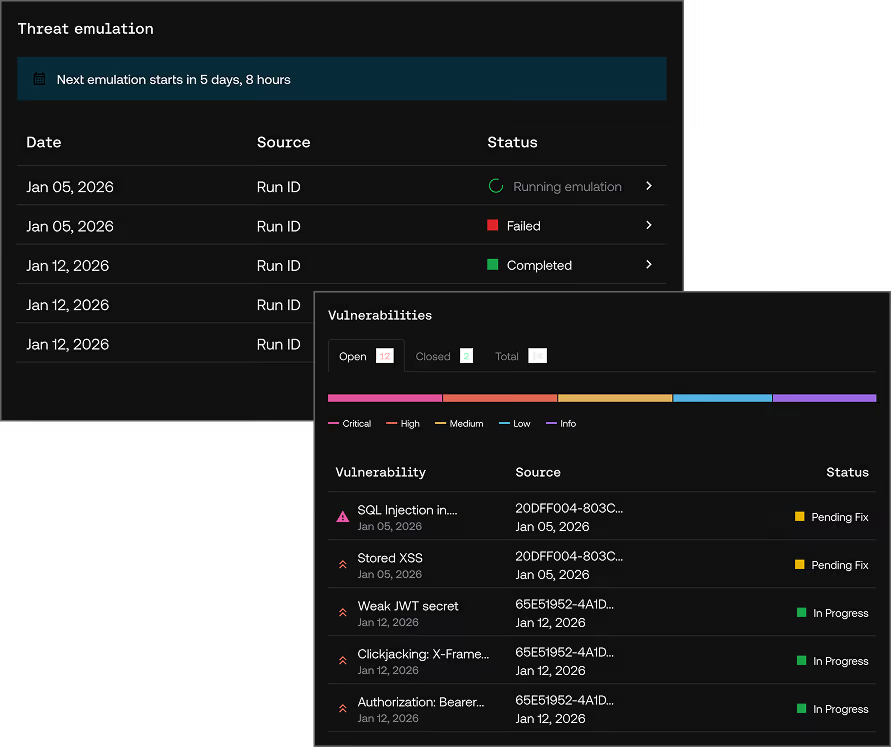
Step-by-step Threat emulation creation
Easily scope, launch, and track your Threat emulation with full transparency.

Human triaging & peer review
Expert human validation before customer delivery, for accuracy and impact.

Full visibility
Track every finding with complete transparency through security expert work logs and real-time notifications.

Seamless integrations
Connect directly with Slack, Teams and Jira to streamline collaboration with your security and development teams.

Vulnerability Manager
Visualize, manage, and retest vulnerabilities in one platform, with full context on severity, sources, and remediation.

Reporting that supports audit and compliance programs
Generate up-to-date reports with evidence per finding to support your PCI DSS, HIPAA, ISO 27001 and SOC 2 programs. Strike does not issue SOC 2 reports, ISO certificates or PCI DSS attestations.

Ongoing partnership
Weekly check-ins with a dedicated Customer Success Manager, plus personalized onboarding and strategic planning.
More than an offensive security platform, Strike operates as a continuous validation layer for environments that never stop changing.

Trusted by security teams that lead






Human expertise.
AI power.
Superior security.
Whether you’re scaling fast, closing enterprise deals, or just tired of noisy reports, we’ll help you build a security stack that moves faster than your threats.
